01
Steam discovery
Finds the Steam installation, additional libraries, installed games and local Steam profiles by reading registry and VDF data.
A .NET 10 desktop application for discovering Steam games and profiles, resolving known save locations, and moving save data through workflows designed to be previewable, reversible and auditable.
Application gallery
Every screen of the current build, captured headless from one commit against synthetic data: the nine workflows in dark and light, the appearance system, the dockable workspace, accessibility, navigation and the three sync providers. Pick a set from the rail - each has its own strip, counter and full-size view.
The tour: all nine sections in dark and light, the five settings categories, and the accent colours spread across the set.
Use the previous and next buttons, or the left and right arrow keys, to browse the screenshots. Home shows the first screenshot and End shows the last.
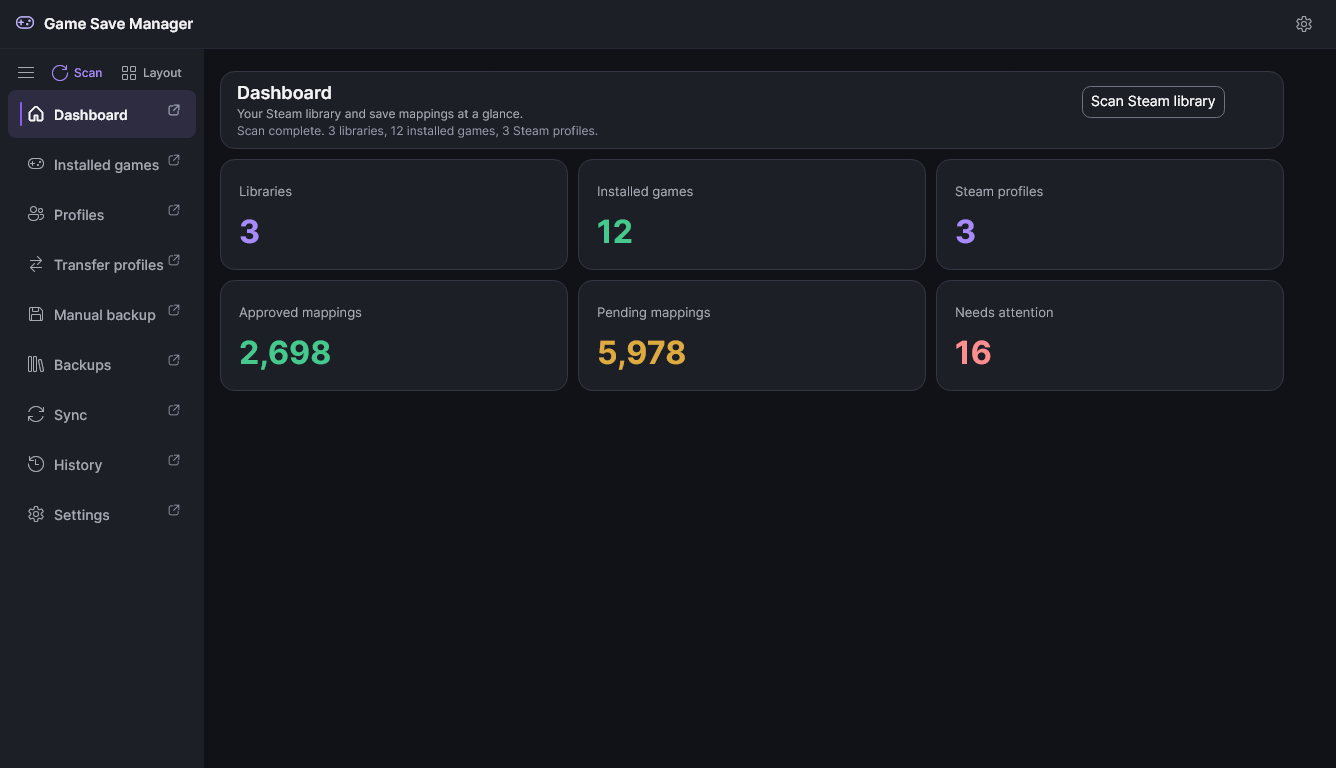
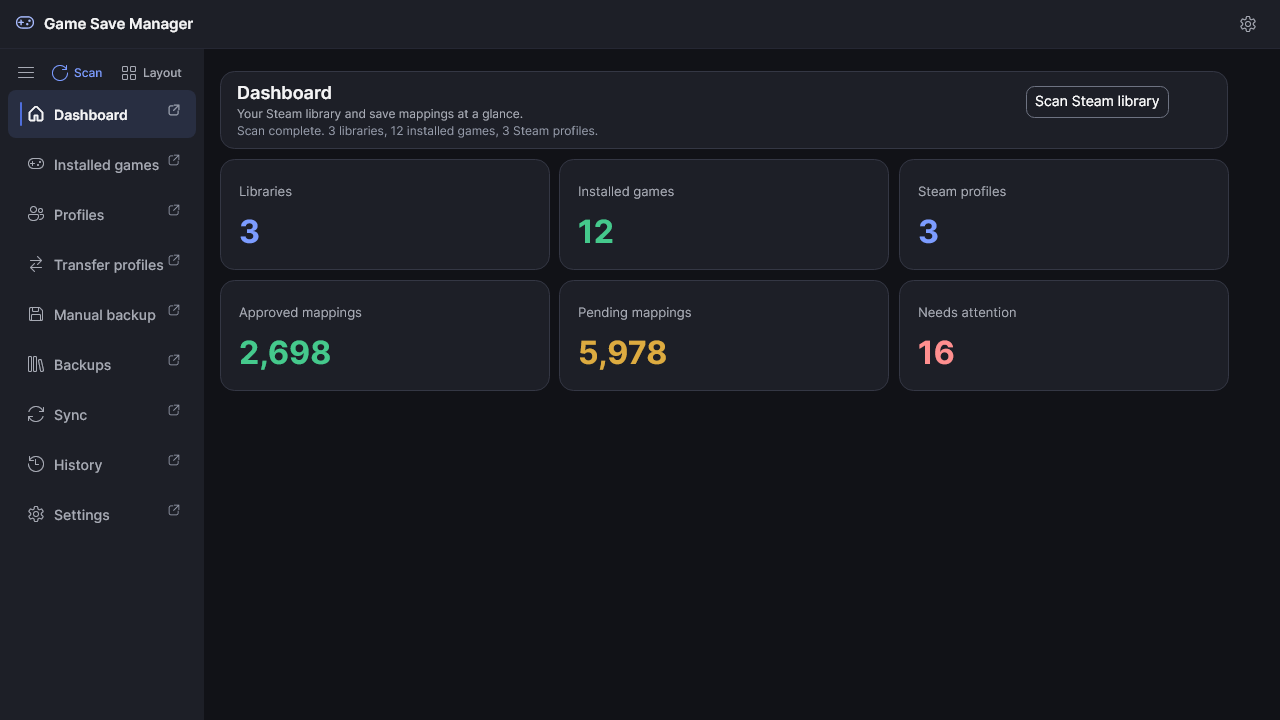
Six stat cards summarise a scanned Steam library - 3 libraries, 12 installed games, 3 Steam profiles, 2,698 approved save mappings, 5,978 pending and 16 needing attention - under a page header with the Scan Steam library action.
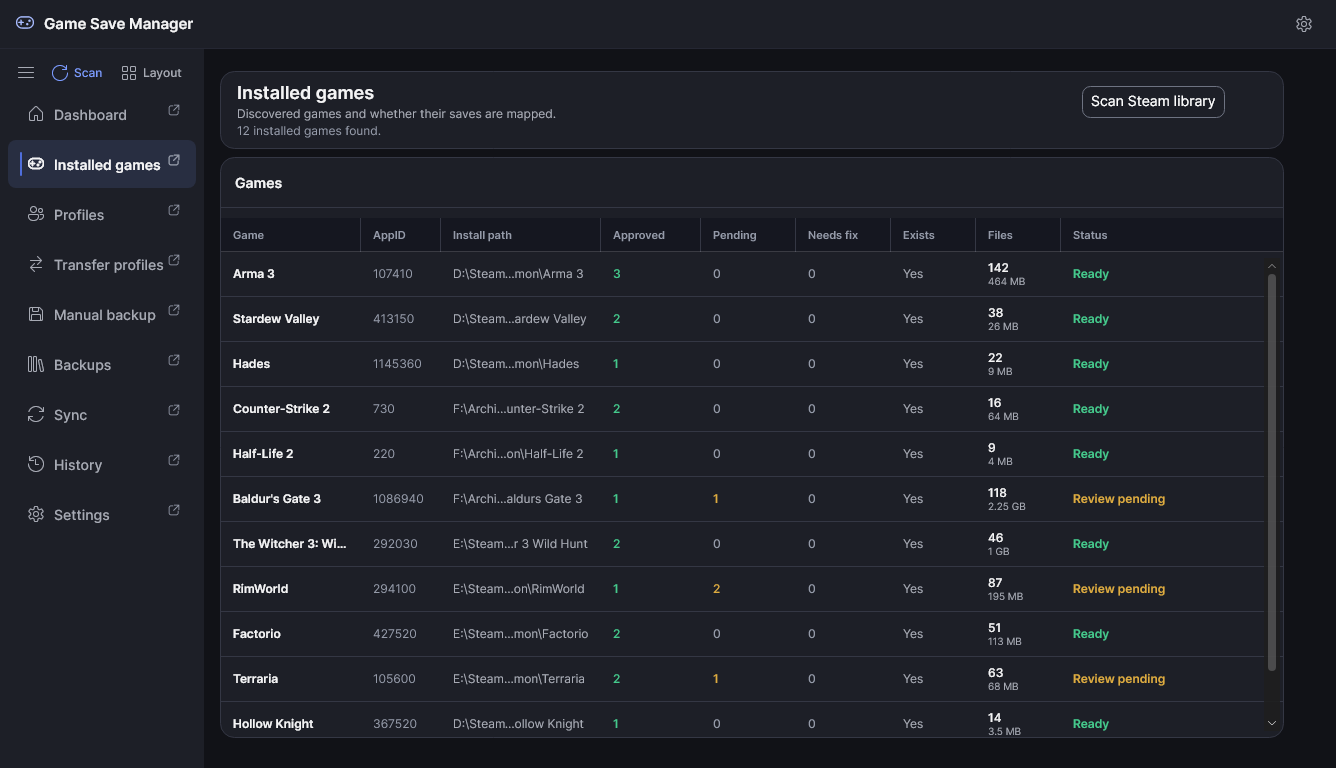
A sortable table of twelve discovered Steam games, each with its AppID, install path, approved, pending and needs-fix mapping counts, whether the save path exists, file count and size, and a colour-coded Ready, Review pending or Needs attention status.
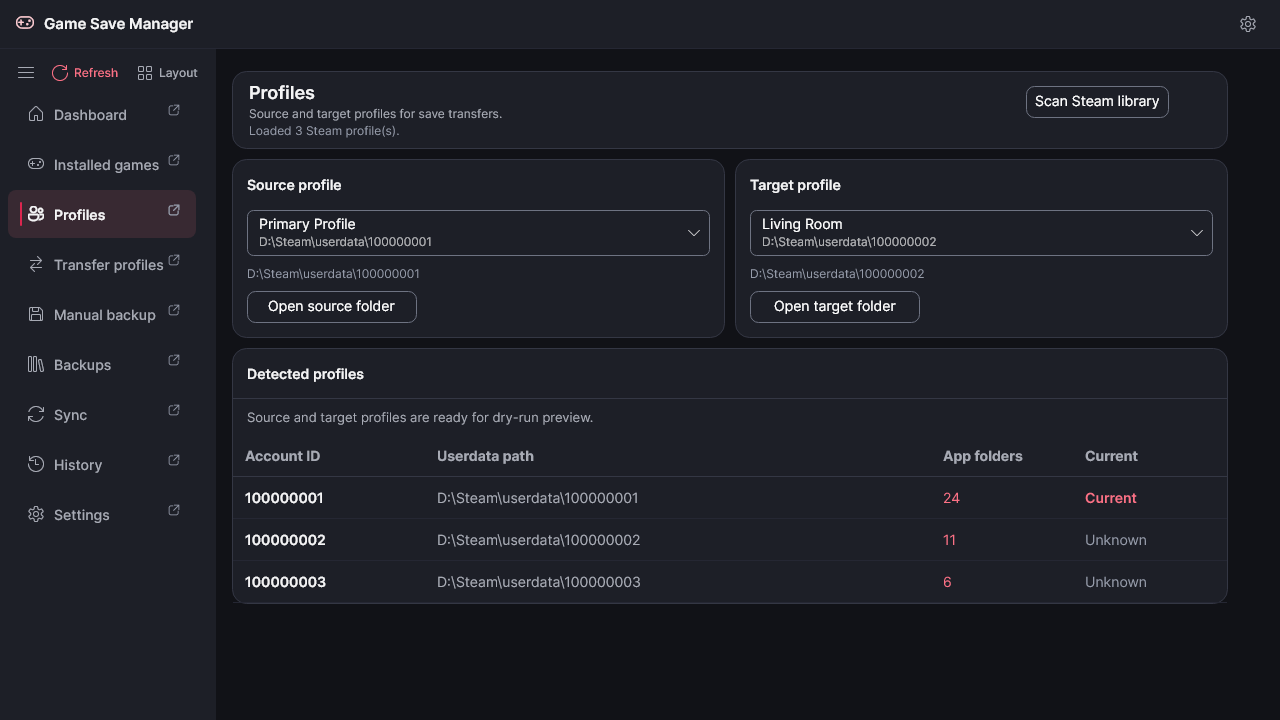
The source and target Steam profile selectors side by side, each with its userdata path and an Open folder action, above a table of three detected profiles with account id, userdata path, app-folder count and which one is the current user.
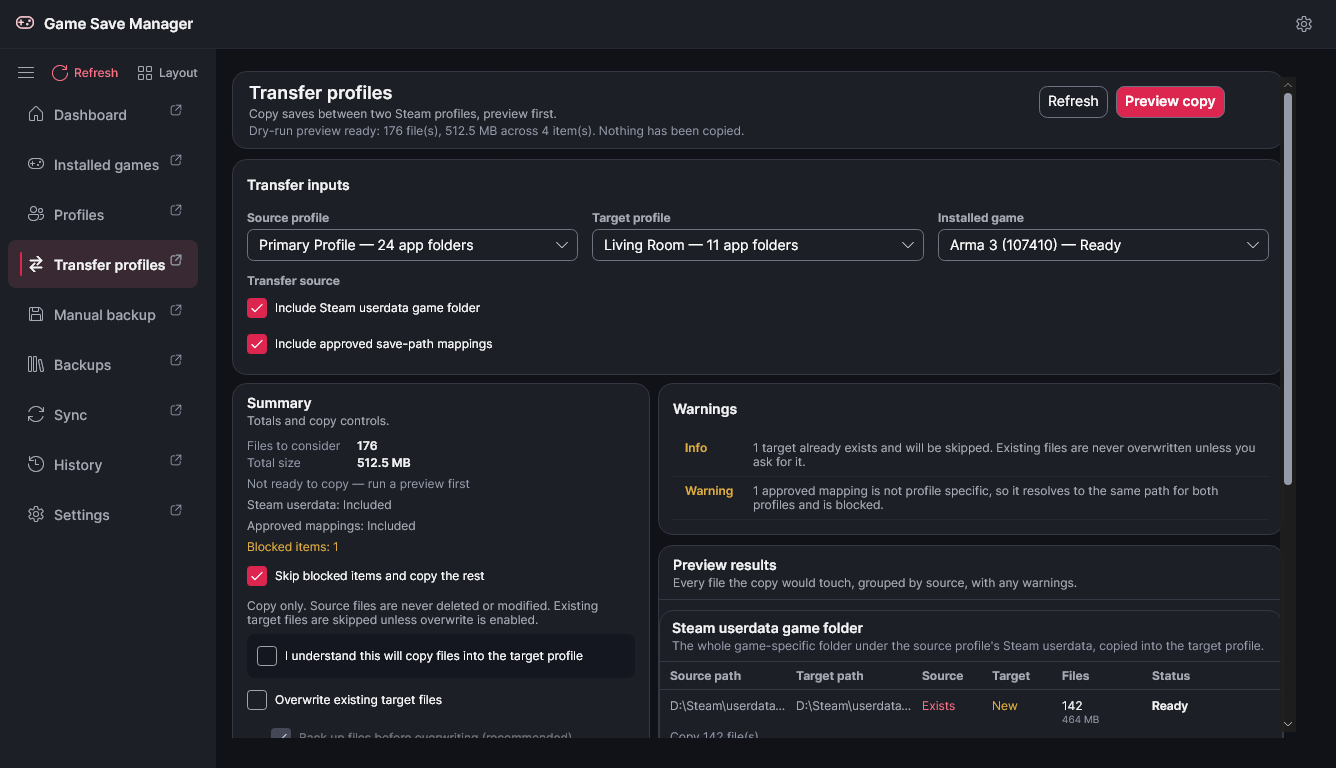
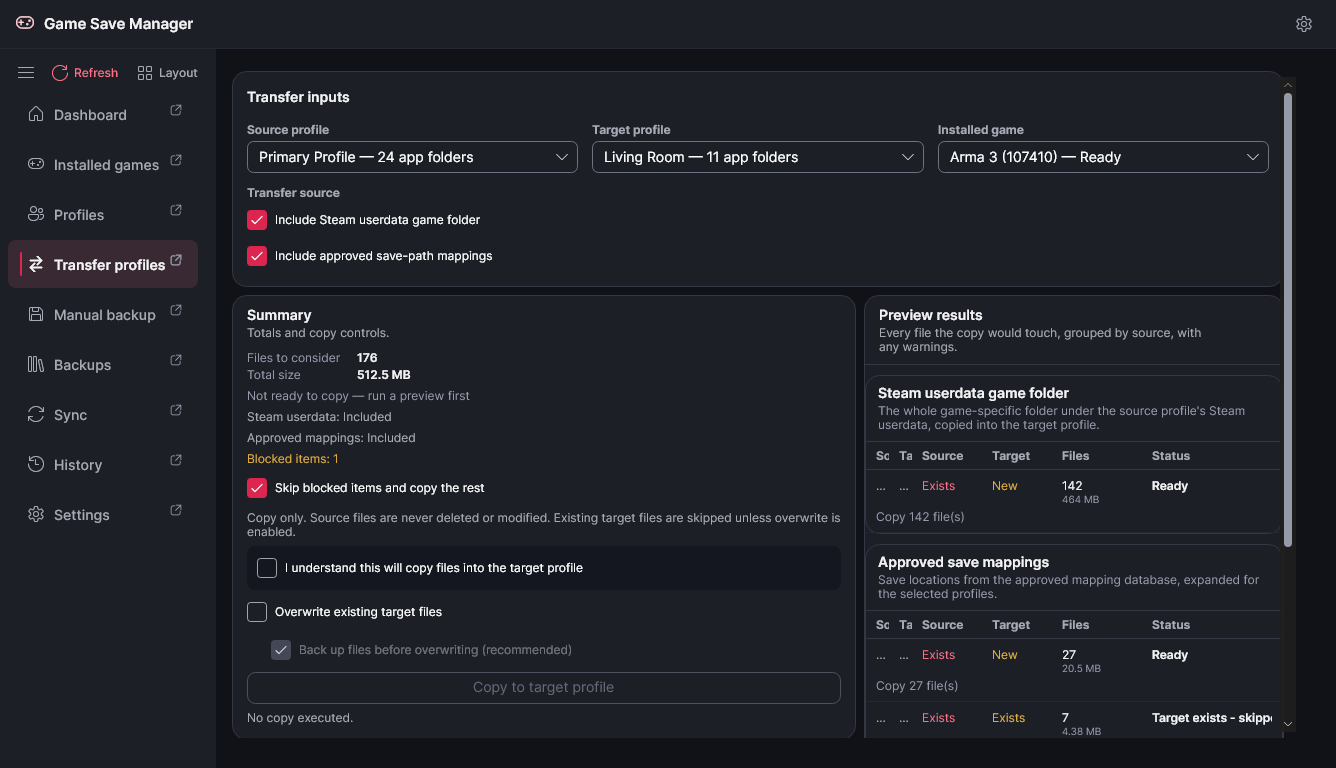
A dry-run preview of copying saves from one Steam profile to another: the file count, total size, blocked items and the confirmation and overwrite switches on the left; warnings and per-item results grouped by source on the right, each marked Ready, skipped or blocked. Nothing has been copied.
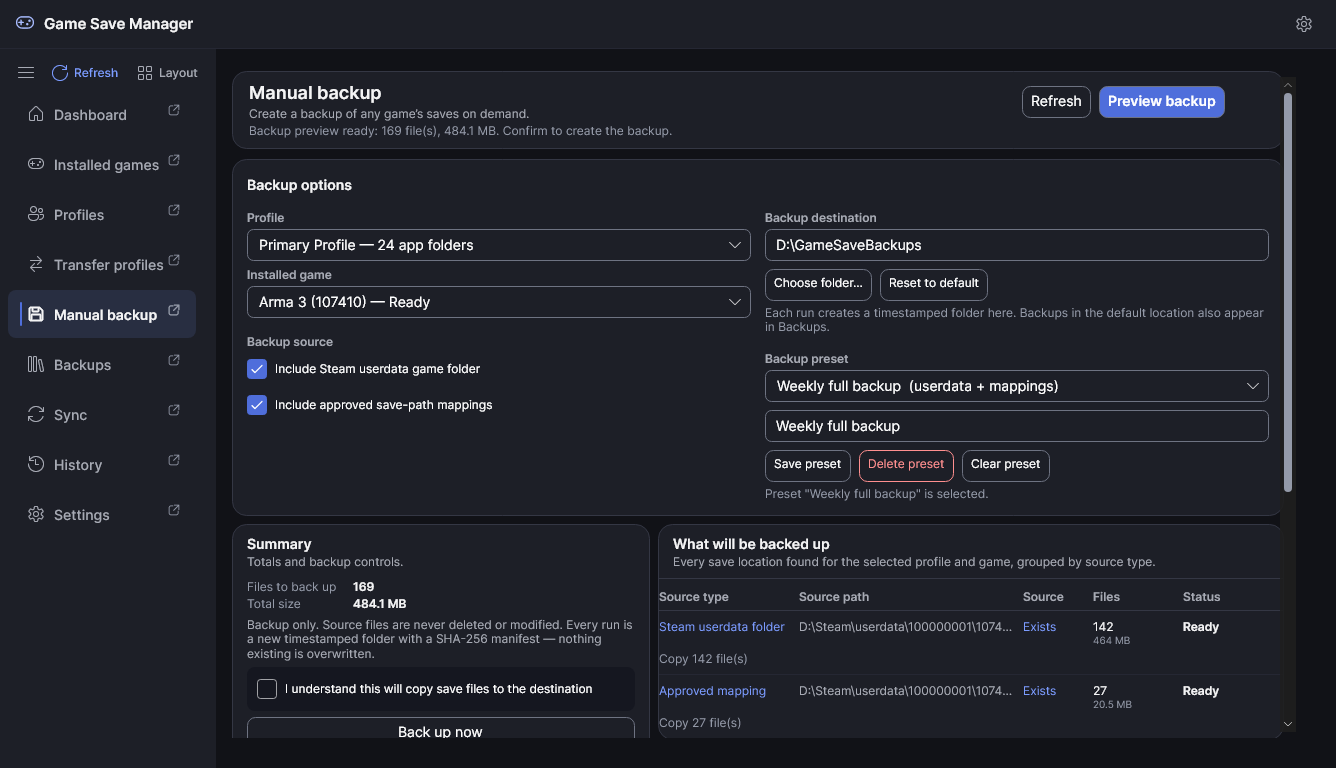
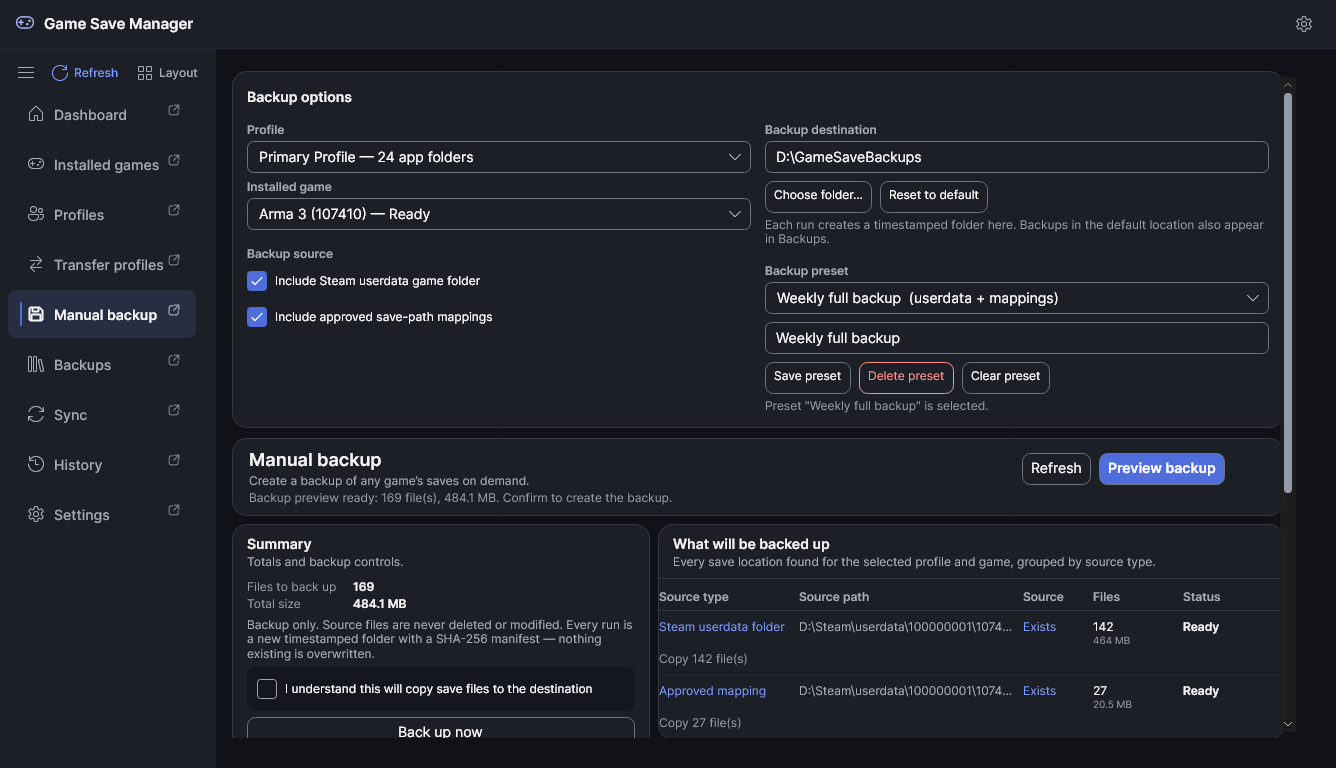
Filled in and ready: profile, installed game, backup destination, the two source switches and a saved preset, beside a summary of what would be backed up - 169 files, 484.1 MB - and a preview listing each save location.
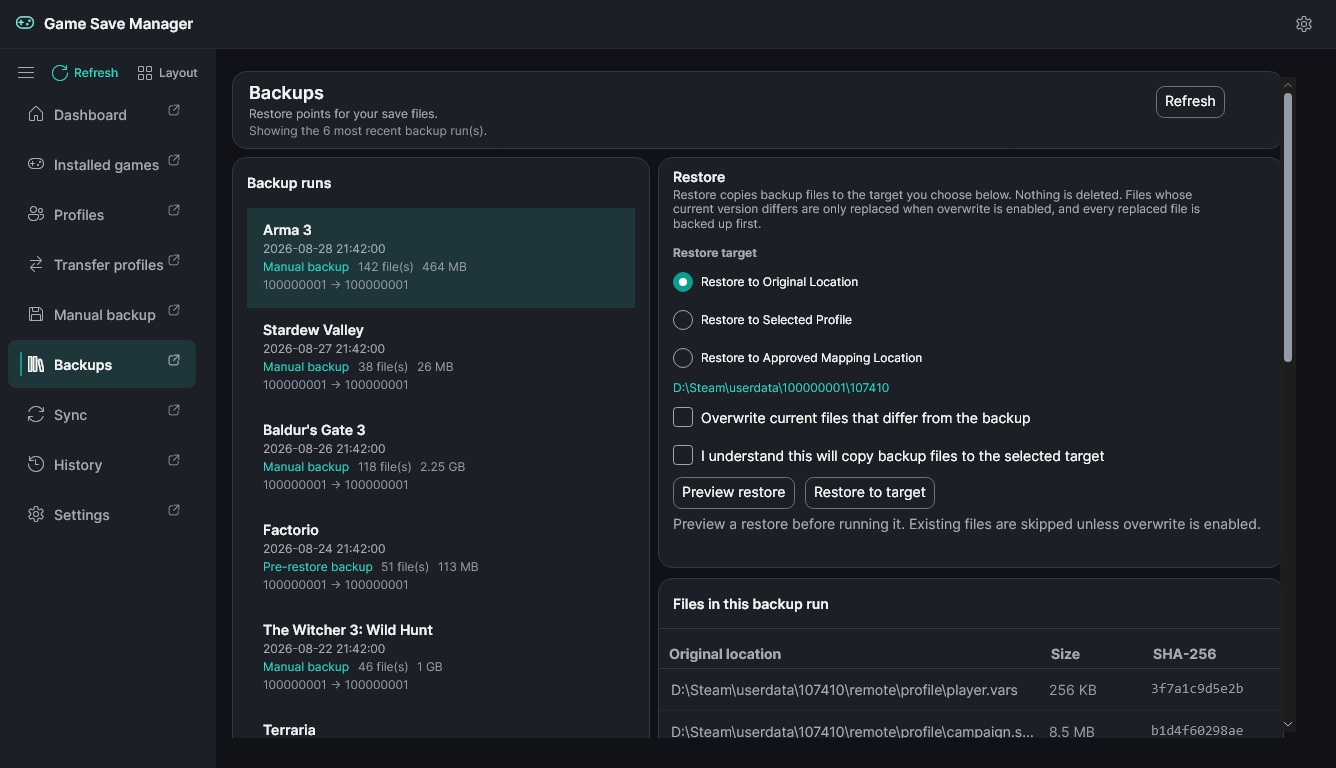
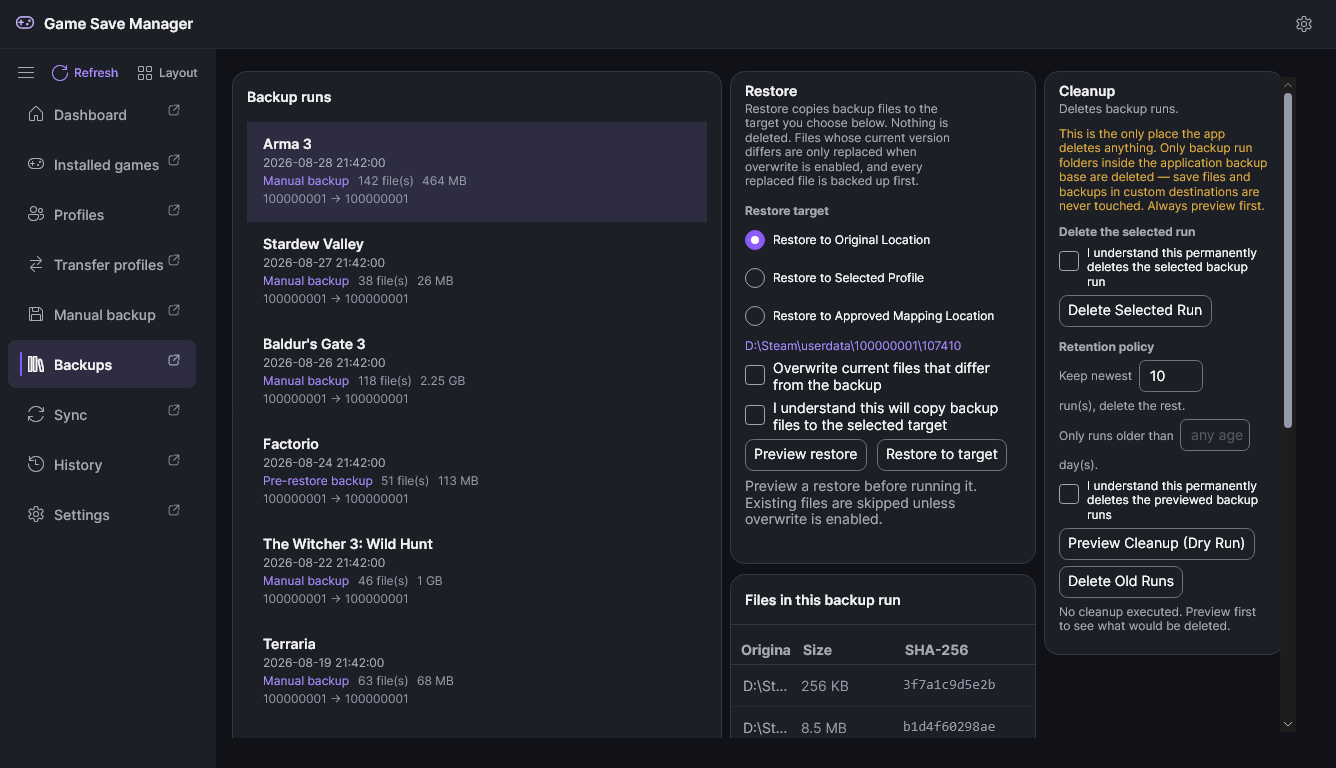
Six recorded backup runs on the left, each with its game, timestamp, kind, file count and size; on the right the restore target options, the files in the selected run with their SHA-256, the ZIP archive actions and the cleanup retention policy.
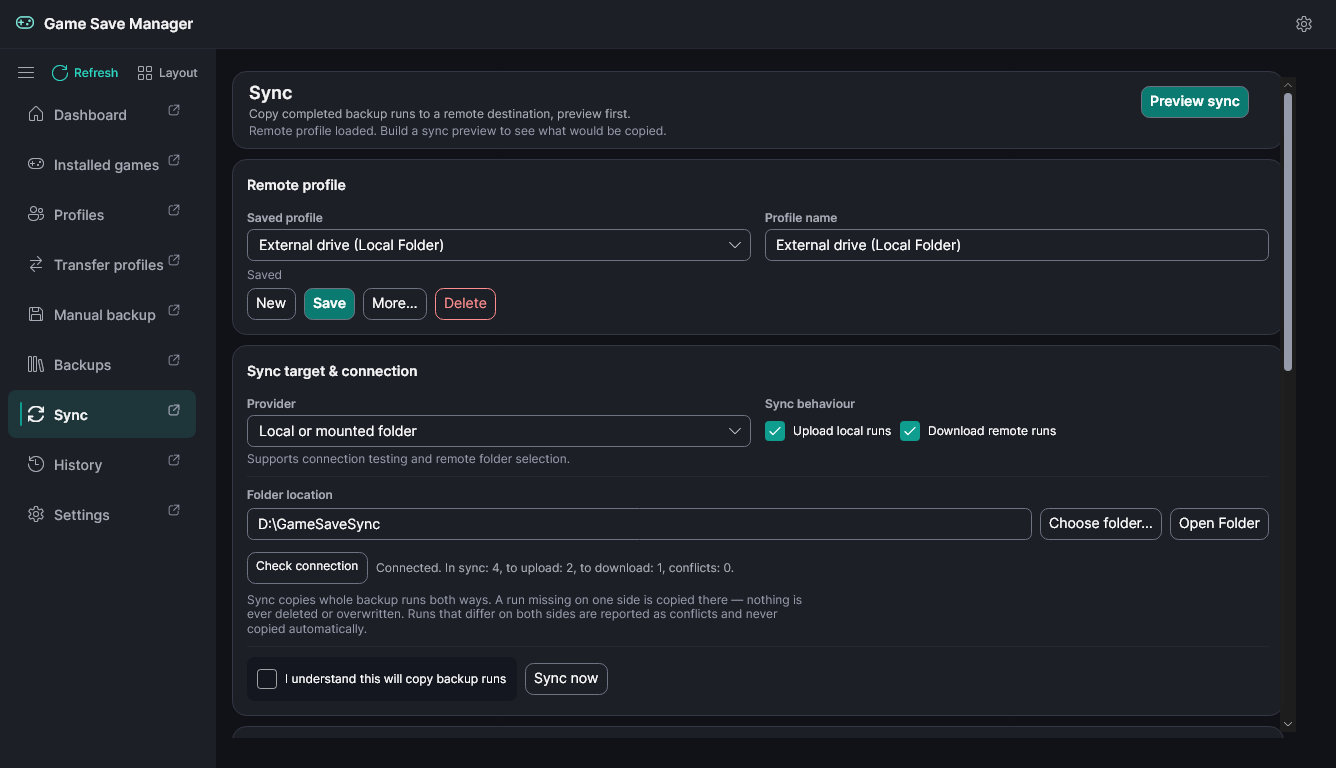
A saved Local Folder remote profile loaded: the remote profile selector with its New, Save, More and Delete actions, then the provider choice, the sync target path and the upload and download switches.
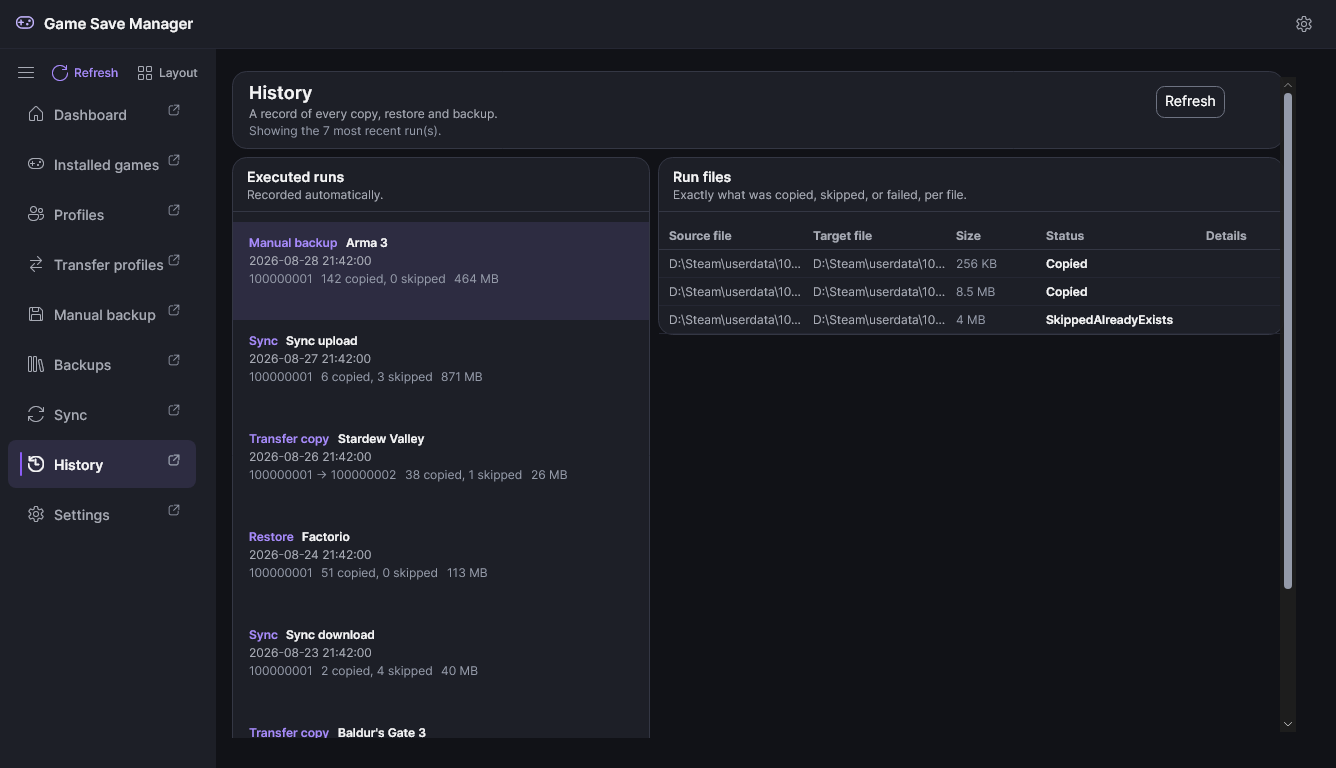
Seven executed runs on the left - manual backups, sync uploads and downloads, profile transfers, a restore and a cleanup - each with its timestamp, profiles and file counts; on the right the per-file record of the selected run, with source, target, size and status.
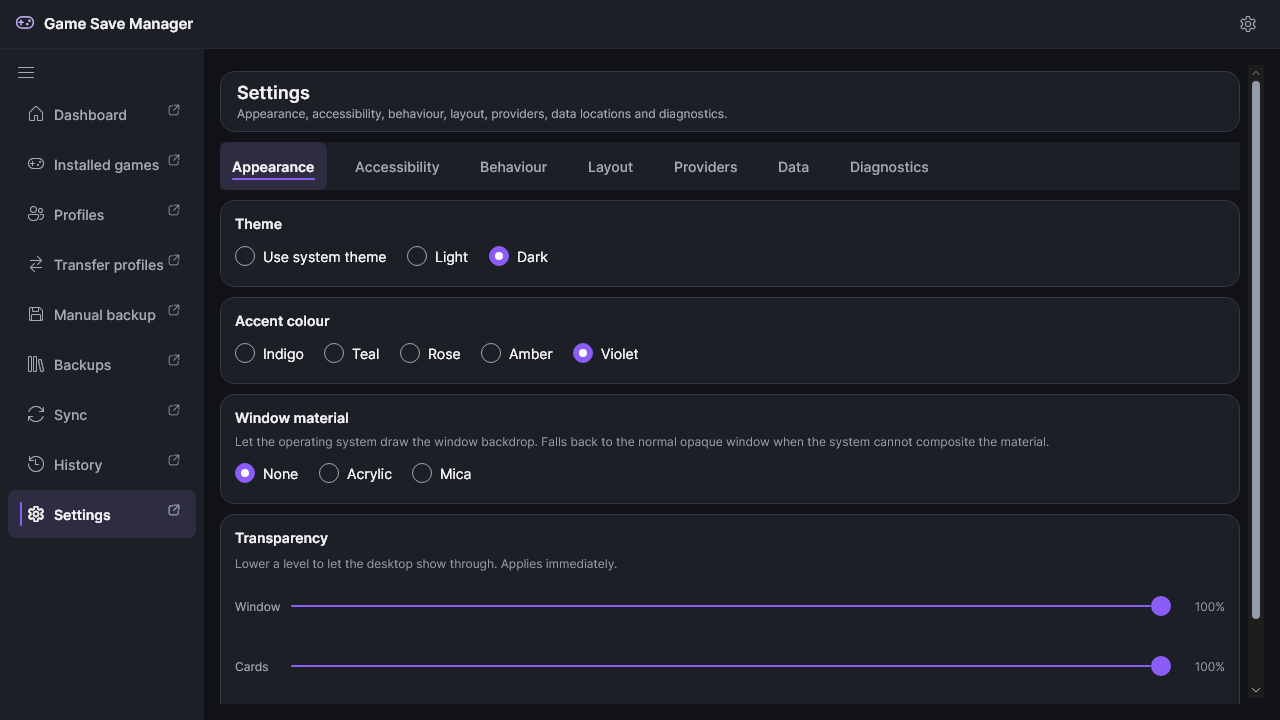
The seven settings categories across the top - Appearance, Accessibility, Behaviour, Layout, Providers, Data, Diagnostics - with Appearance open: theme, accent colour, window material and transparency.
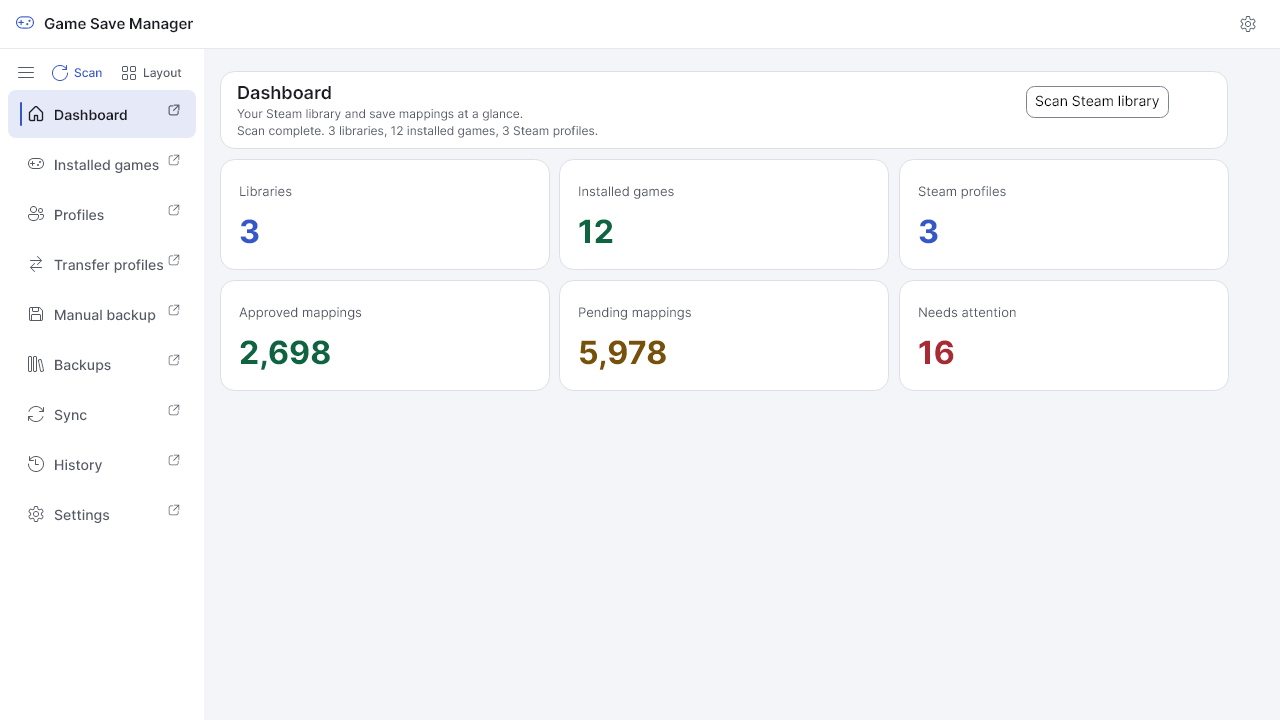
The same Dashboard in light mode with the default indigo accent: six stat cards over the scanned library totals, rail expanded on the left.
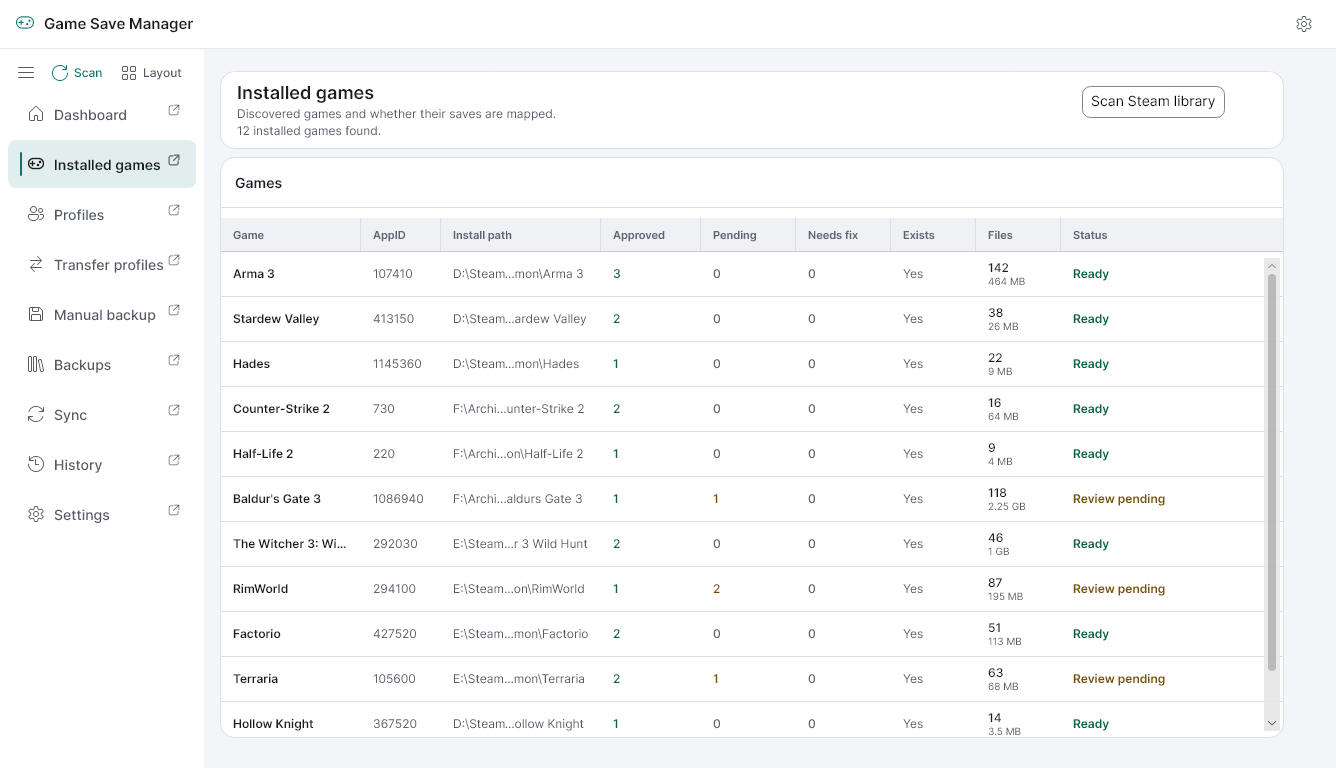
The Installed games table in light mode with the teal accent - the same twelve games, mapping counts and statuses as the dark capture.
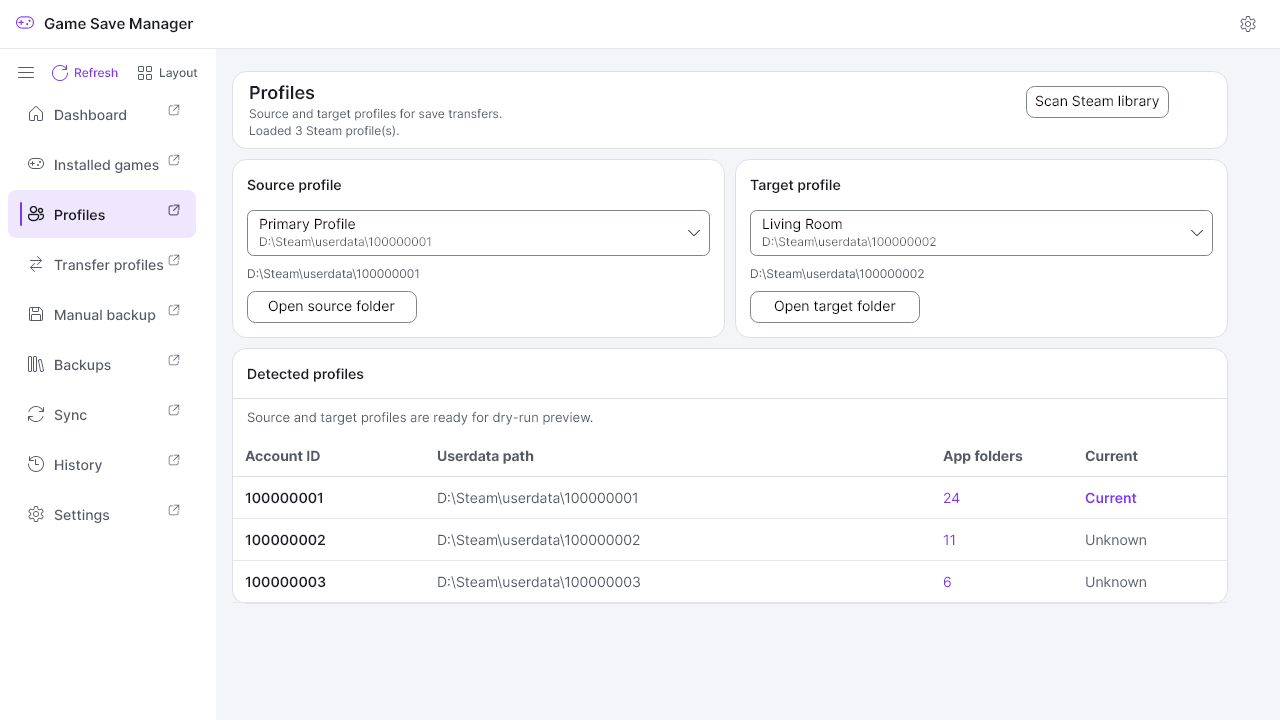
The Profiles page in light mode with the violet accent: source and target selectors above the detected-profiles table.
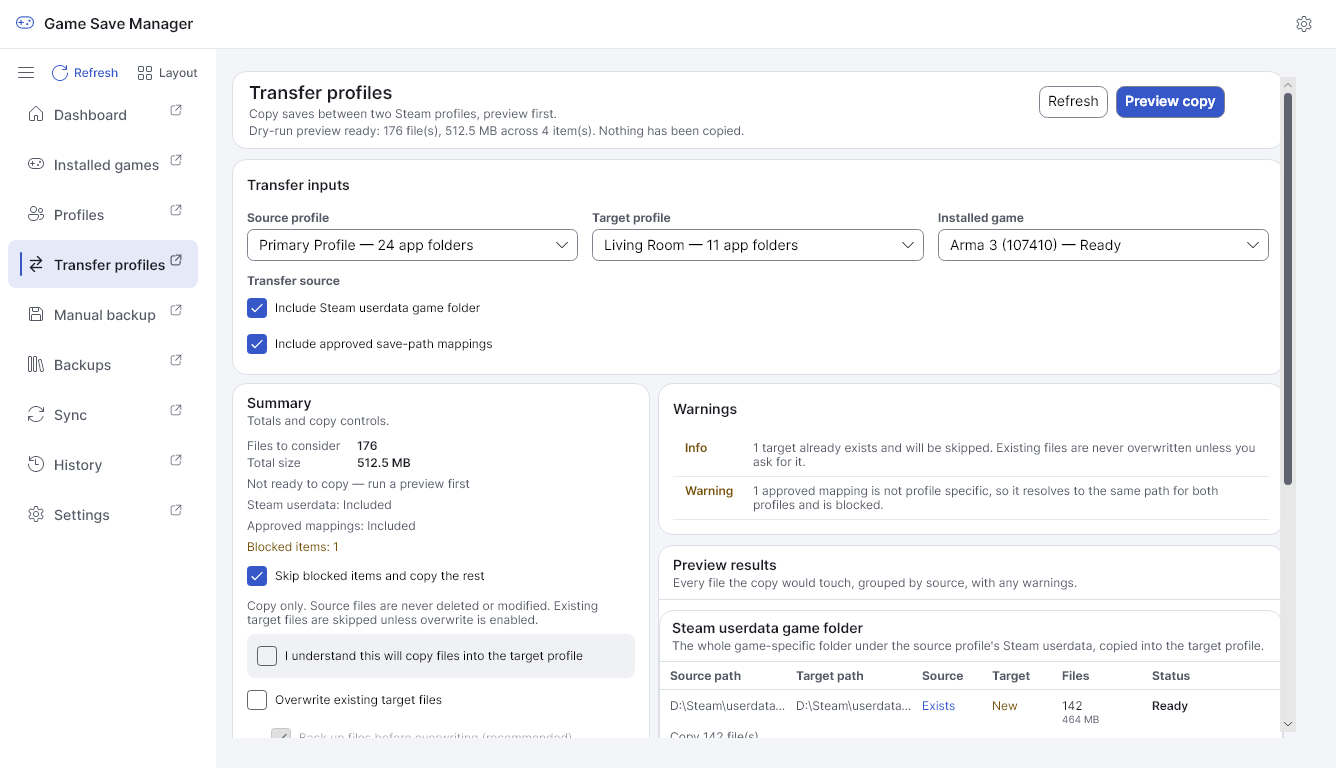
The transfer dry-run preview in light mode with the indigo accent: inputs, summary, warnings and per-item results.
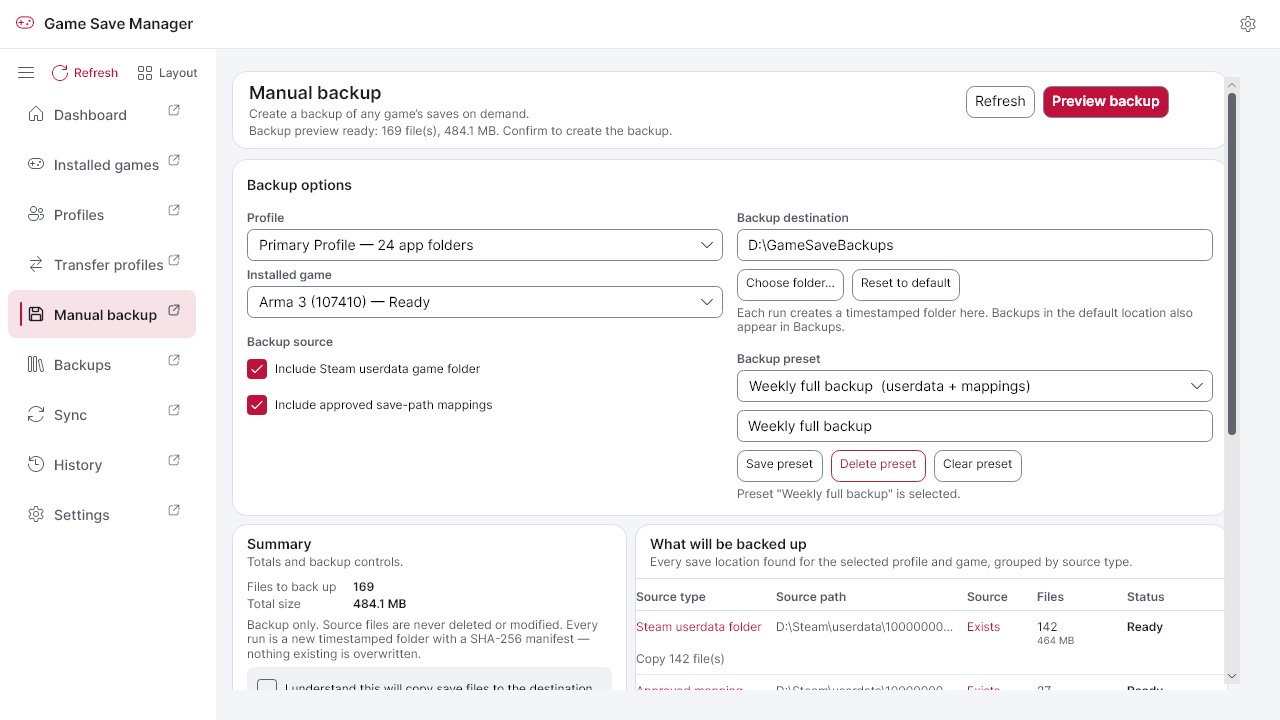
The Manual backup page in light mode with the rose accent, configured and ready to create a backup.
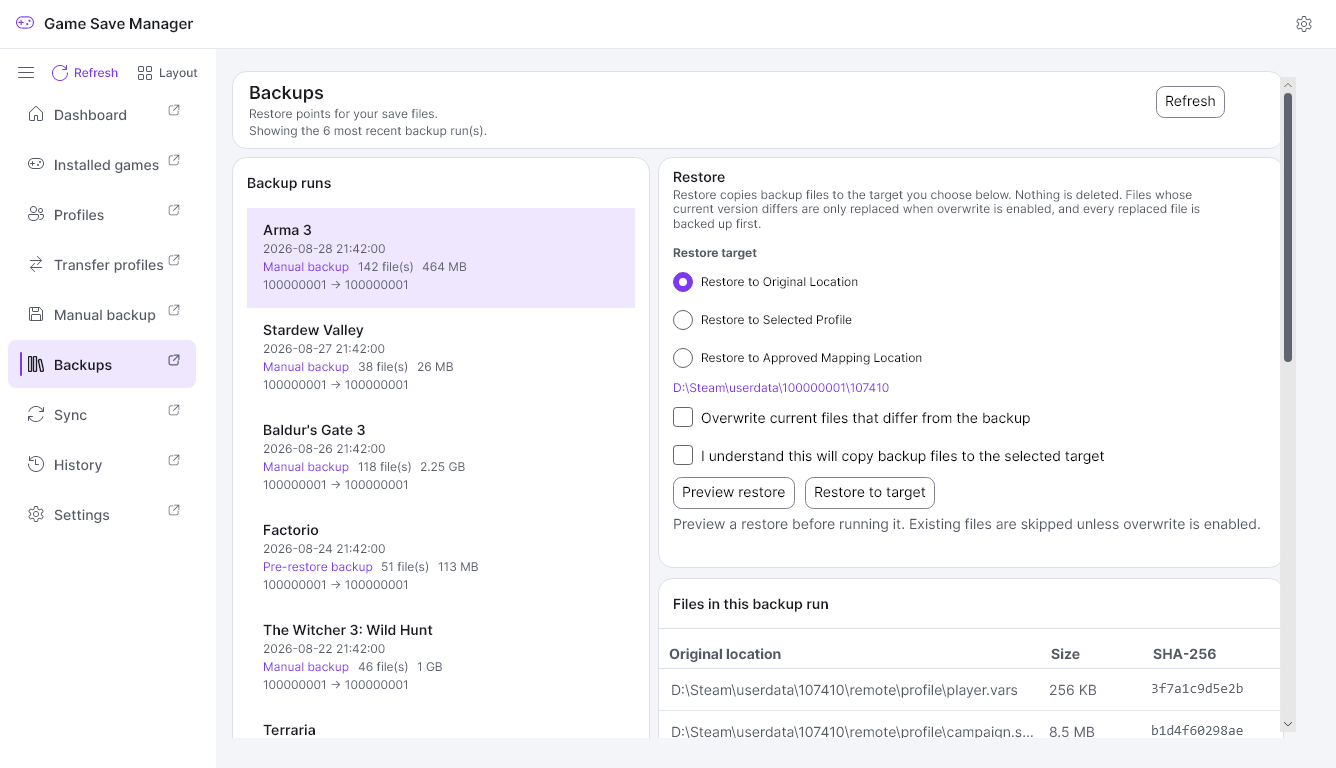
The Backups page in light mode with the violet accent: run list, restore options, run files, archive and cleanup.
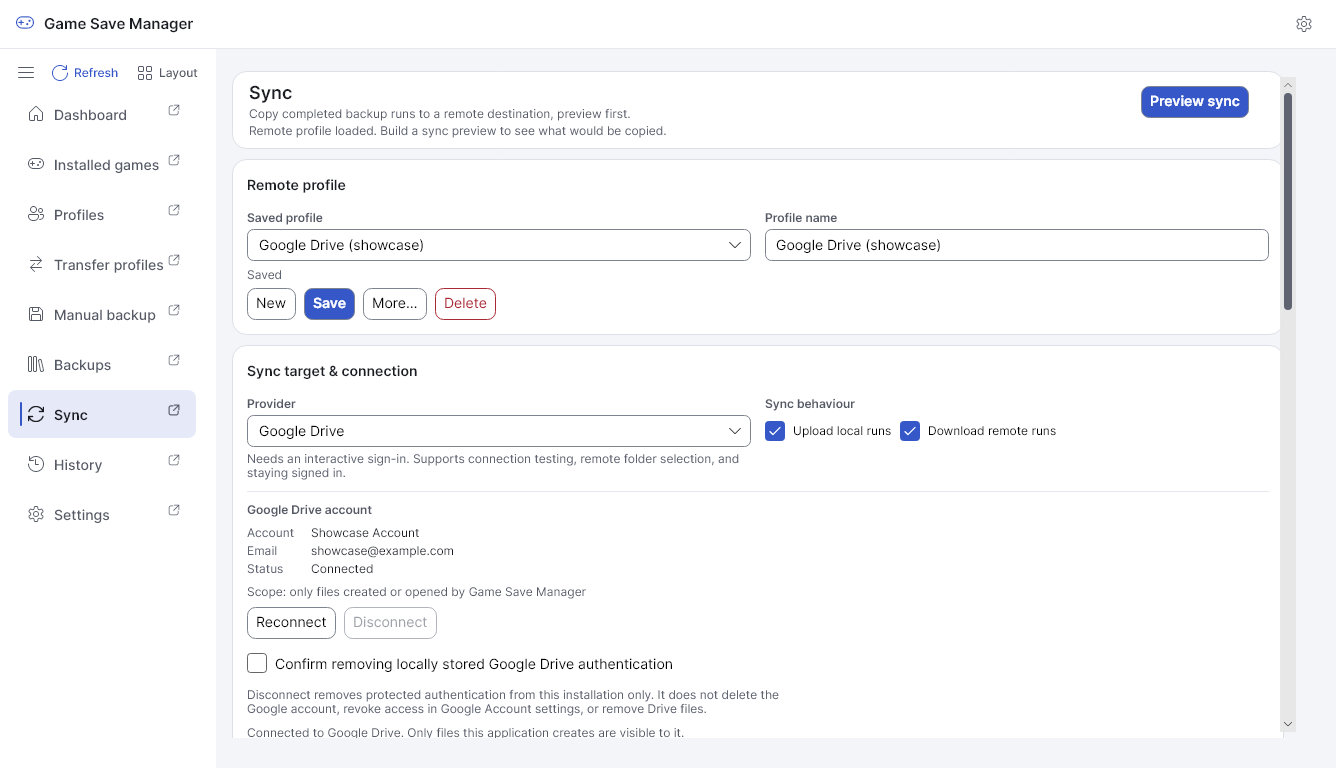
The Sync page in light mode with the indigo accent, connected to Google Drive: the saved remote profile, the signed-in account, the connection status and the application-managed backup folder.
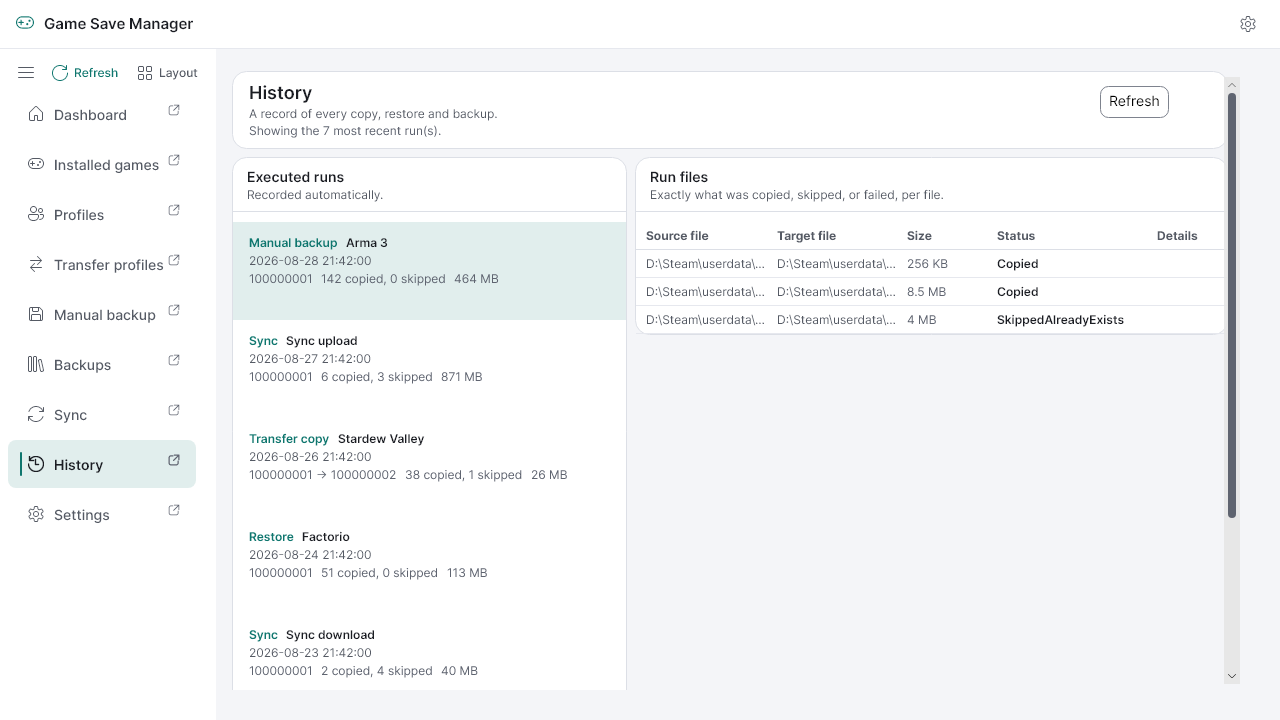
The History page in light mode with the teal accent: executed runs beside the files of the selected run.
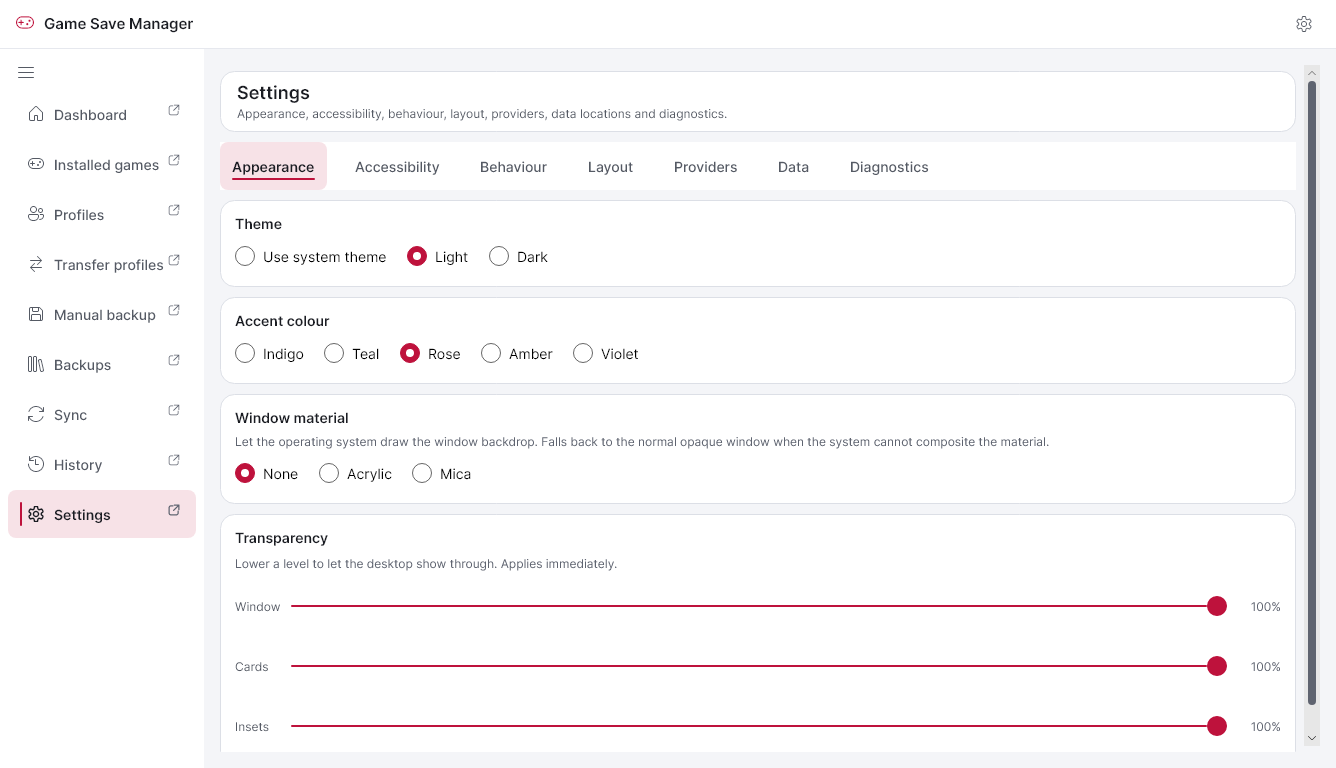
The Settings page in light mode with the rose accent, on the Appearance category.
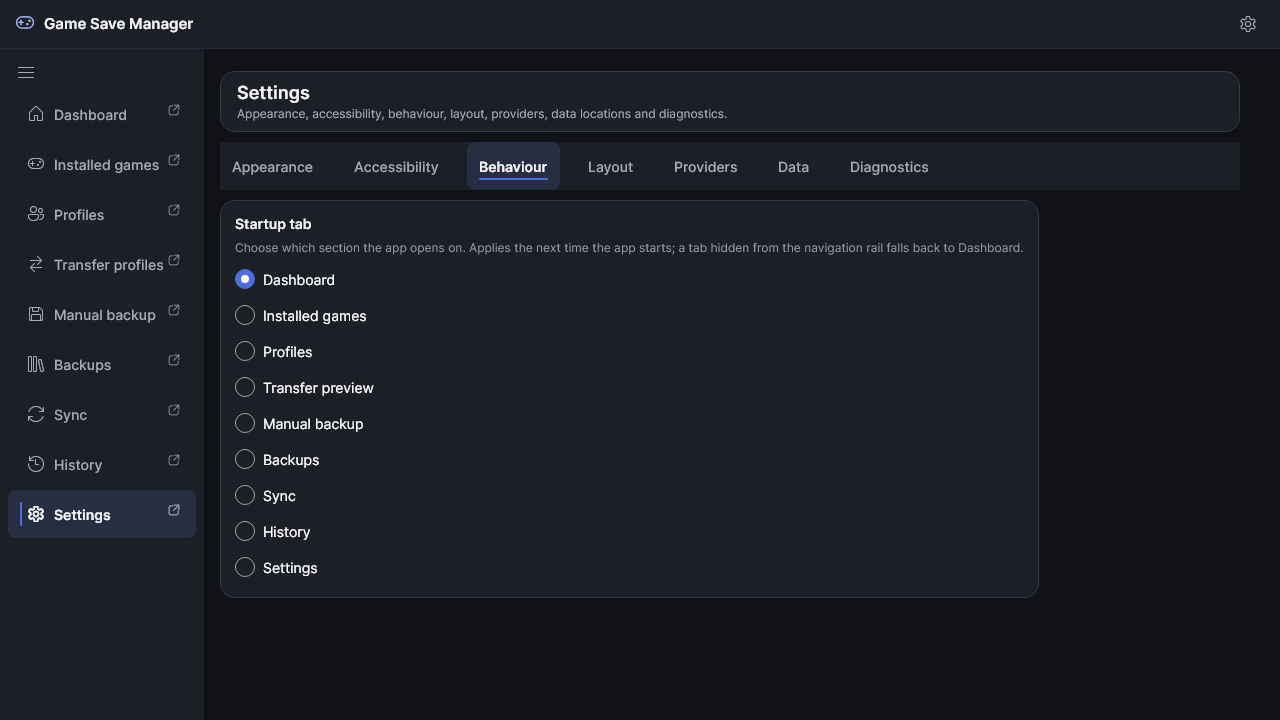
Choosing which of the nine sections the application opens on at start. Dark mode, indigo accent.
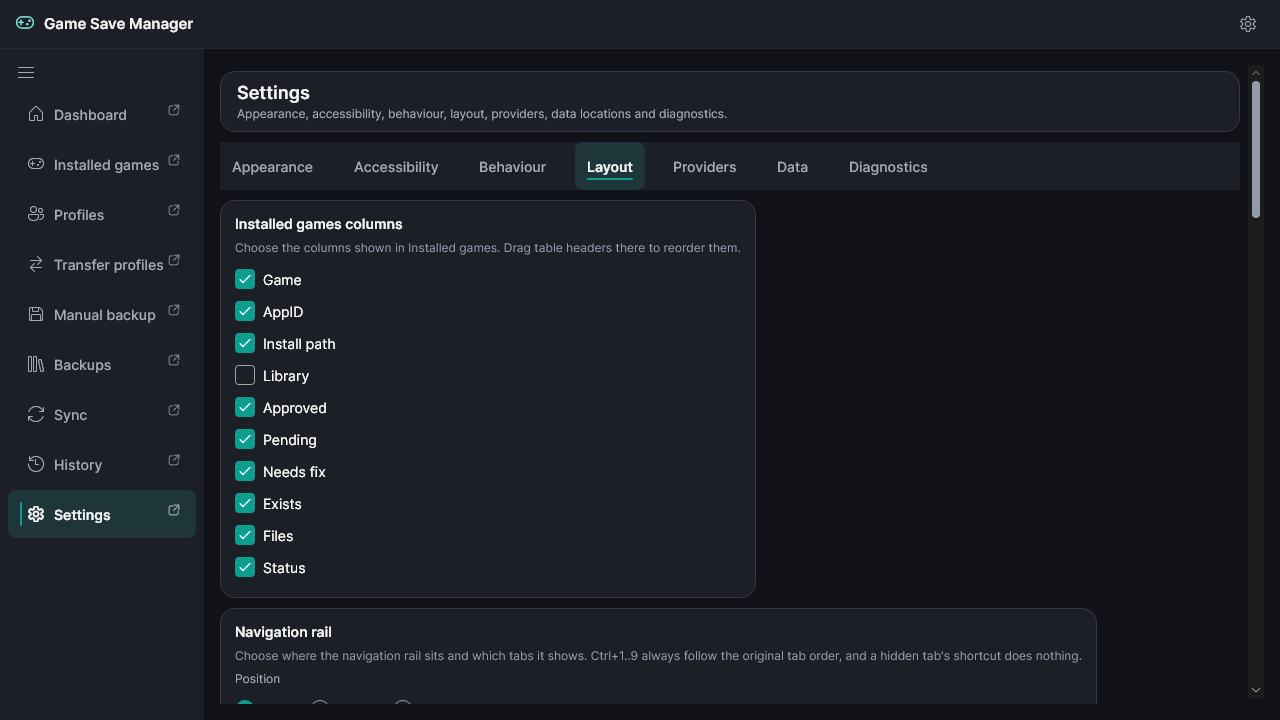
The Installed games column chooser with each column tickable, and the navigation rail position below it. Saved workspace layouts and workspace reset follow further down the page. Dark mode, teal accent.
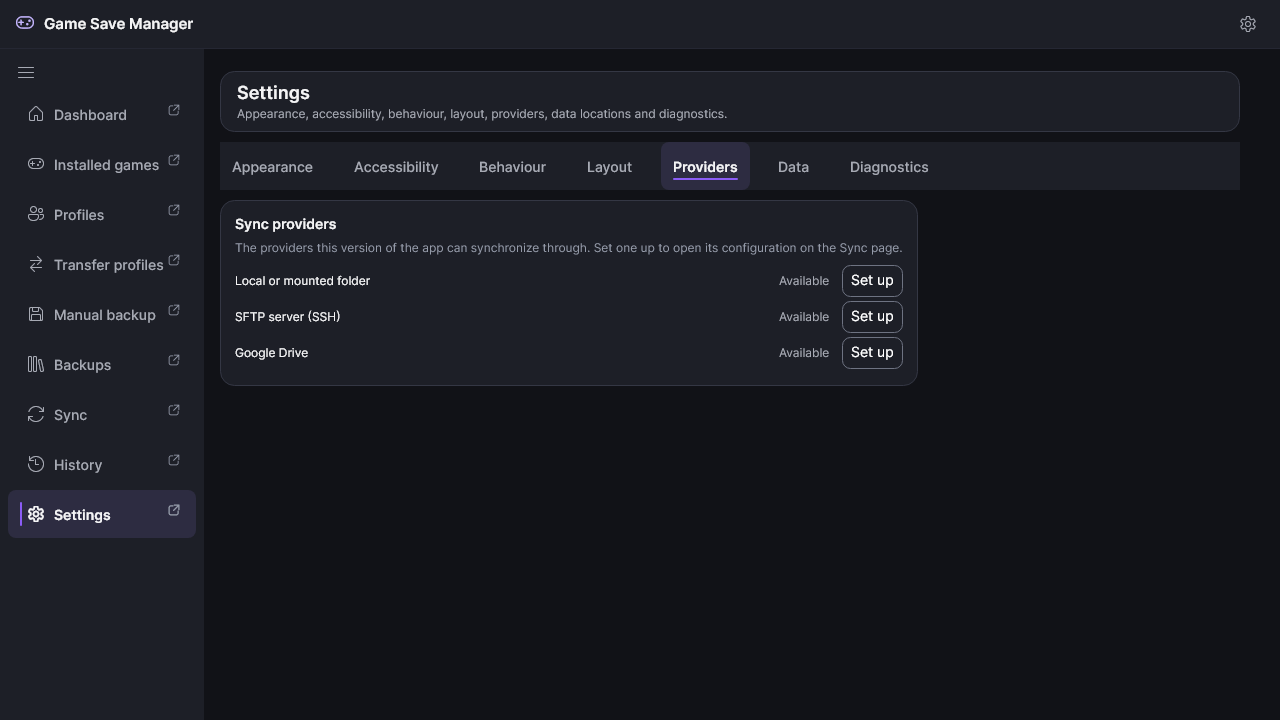
The three sync providers this build implements - Local or mounted folder, SFTP server (SSH), Google Drive - each marked Available with a Set up action. Dark mode, violet accent.
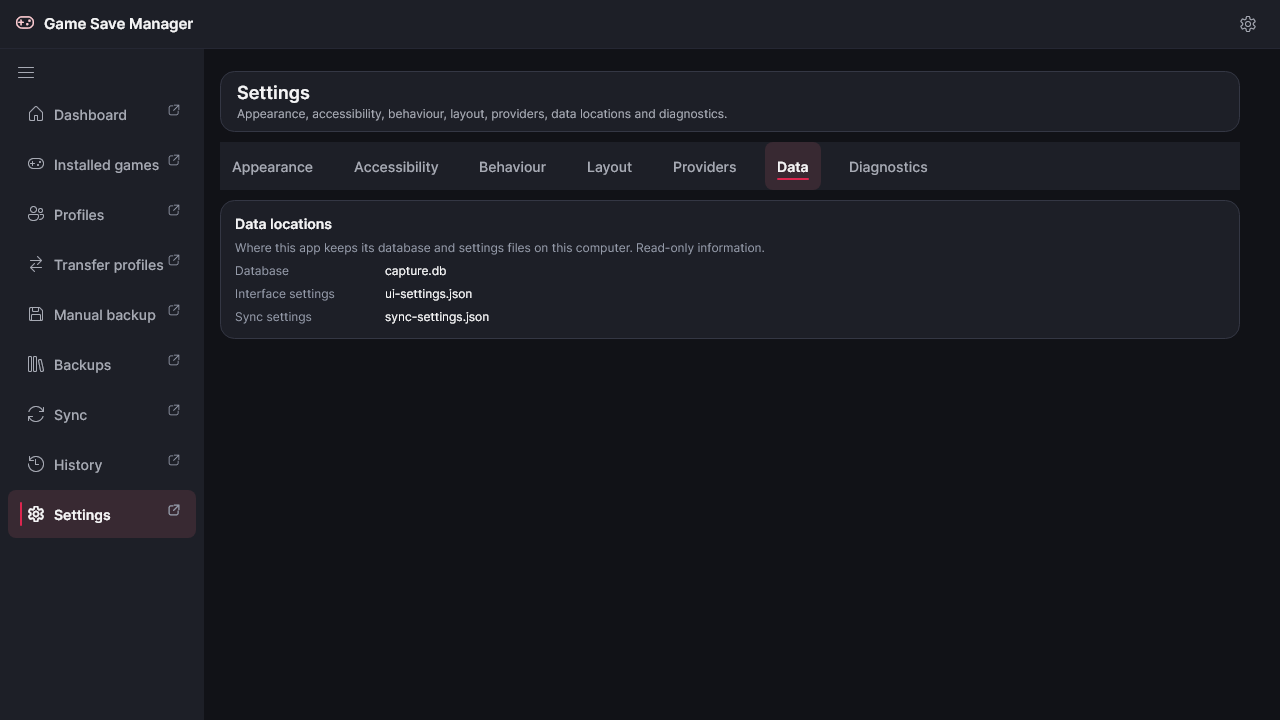
Where the database, the interface settings and the sync settings are kept, read-only. The paths are short because the capture runs in a throwaway directory. Dark mode, rose accent.
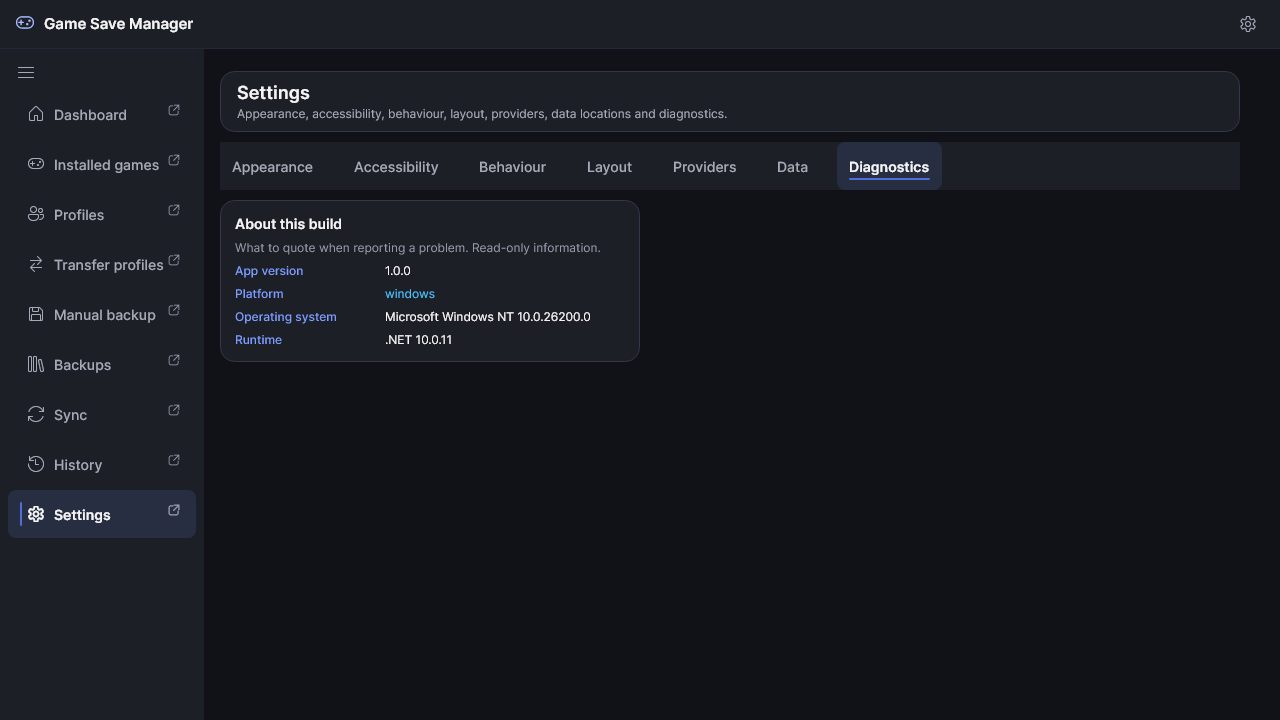
The application version, the platform, the operating system build and the .NET runtime - what to quote in a bug report. Dark mode, indigo accent.
01 / 23
The same screen under different accents and themes - these three differ only in styling.
Use the previous and next buttons, or the left and right arrow keys, to browse the screenshots. Home shows the first screenshot and End shows the last.
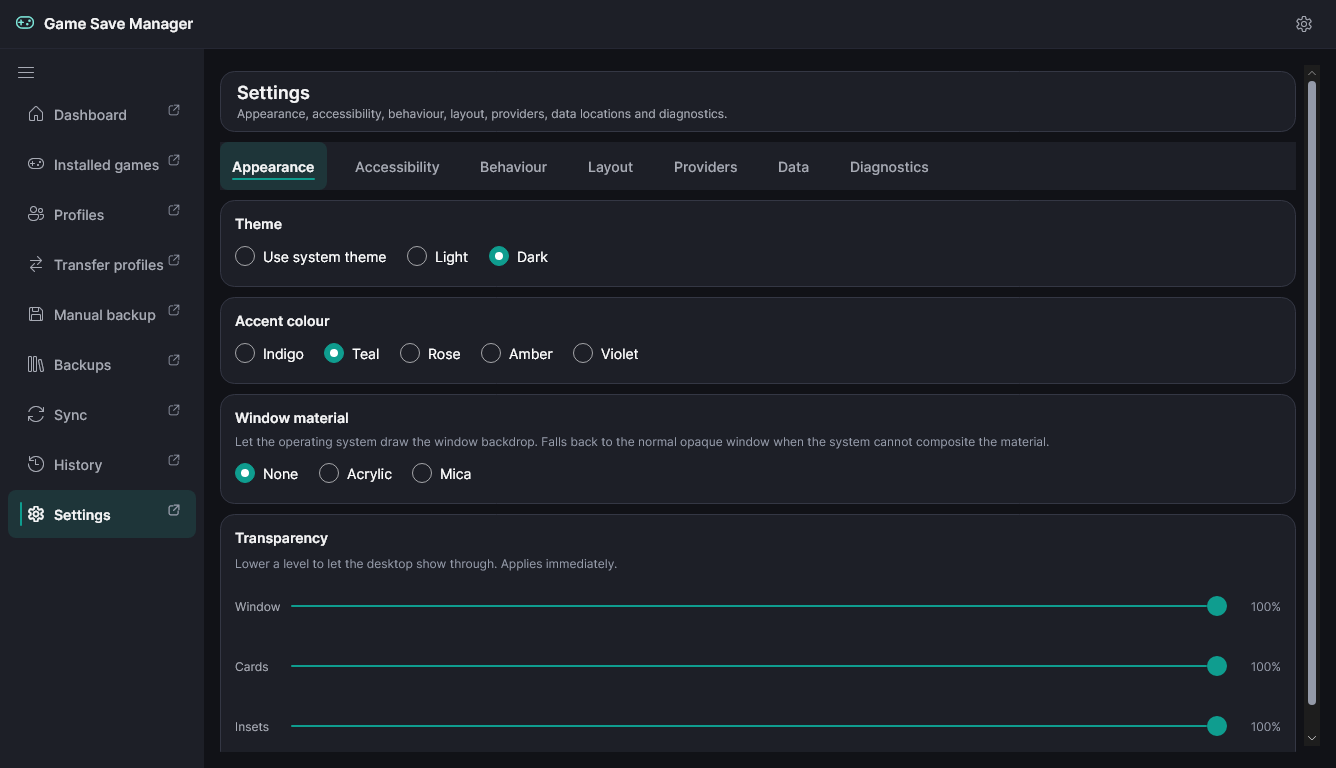
The Appearance category with the teal accent selected: the light, dark and system theme choice, the five accent colours - Indigo, Teal, Rose, Amber, Violet - the None, Acrylic and Mica window material choice, and the window, card and inset transparency sliders.
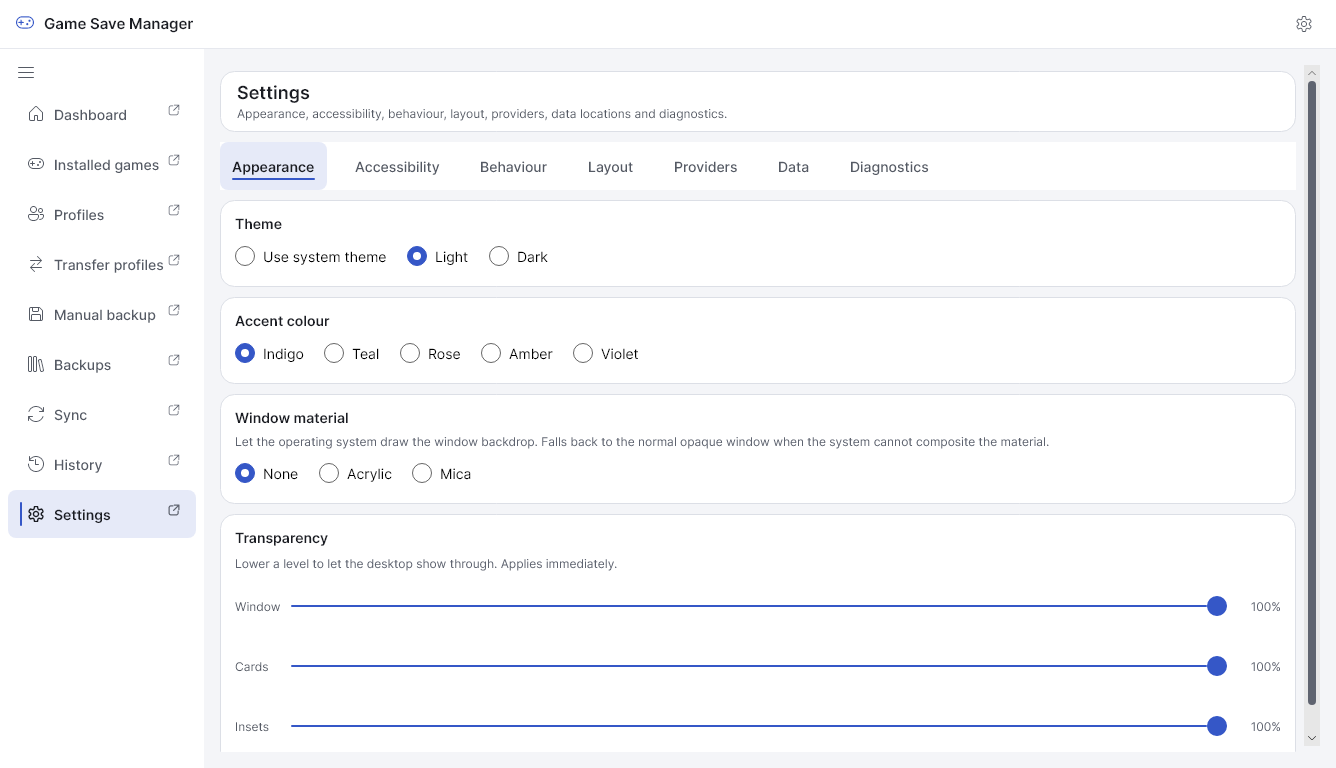
The same Appearance category in light mode with the default indigo accent - the comparison shot for the teal capture.
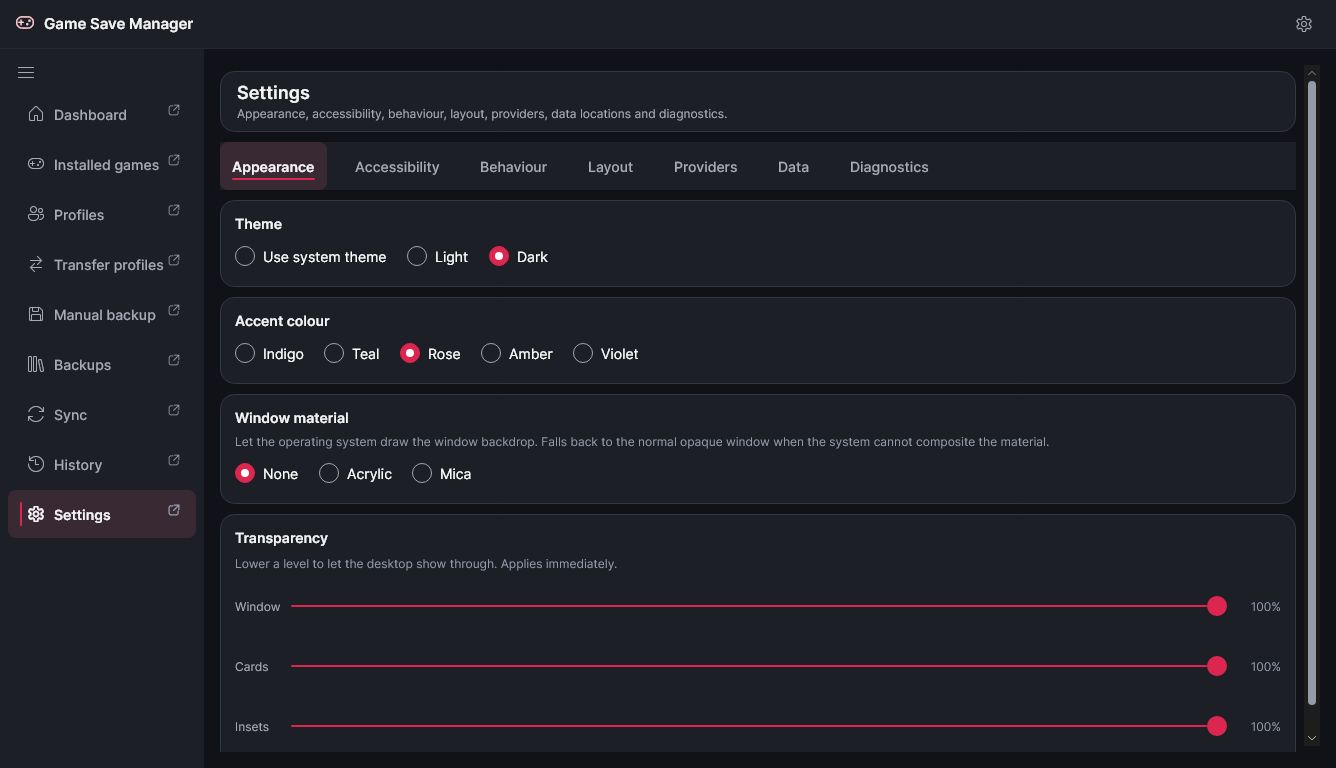
The same Appearance category with the rose accent and the window material set to None.
01 / 03
The IDE-style dockable workspace, in sequence: sections moved between regions, resized, saved and reset.
Use the previous and next buttons, or the left and right arrow keys, to browse the screenshots. Home shows the first screenshot and End shows the last.
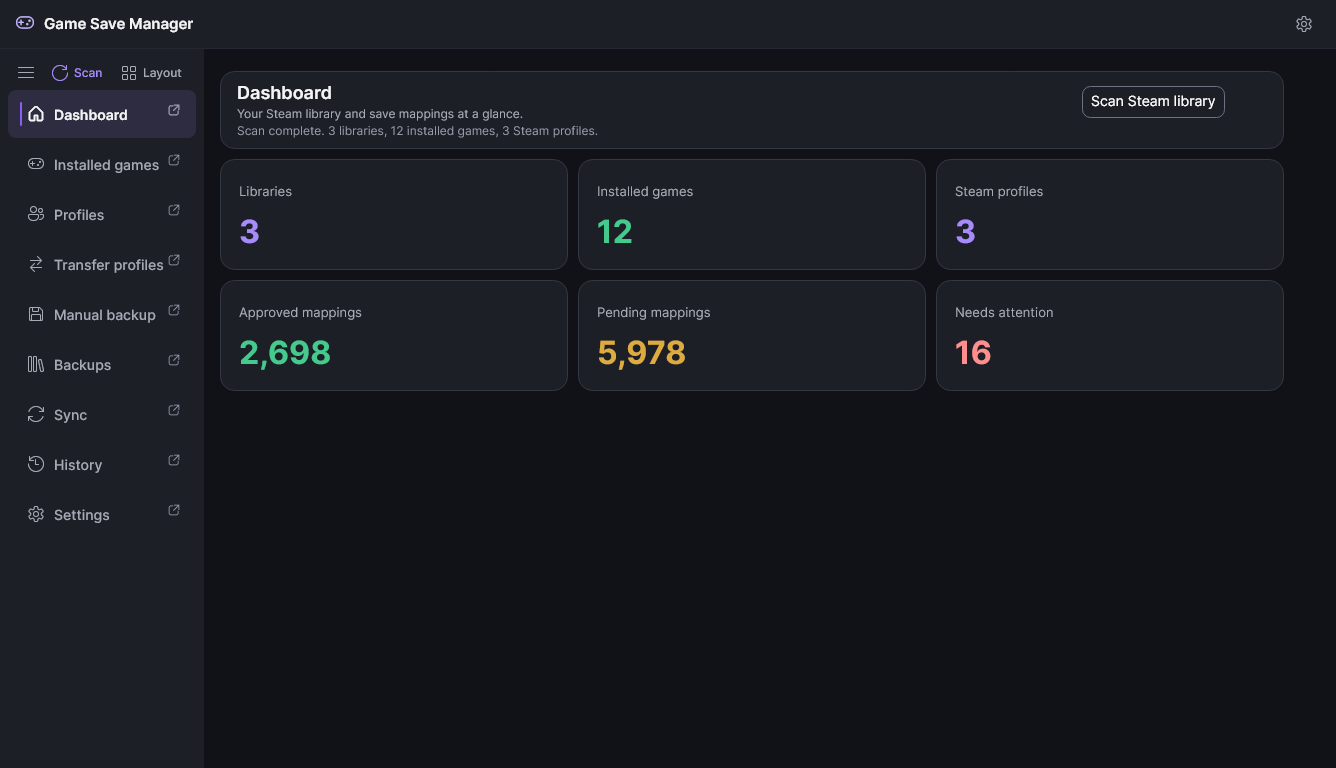
The Dashboard workspace in the arrangement the application ships with: the page header and the six stat cards flowing three across in one centre column. The starting point for the rest of this set. Dark mode, violet accent.
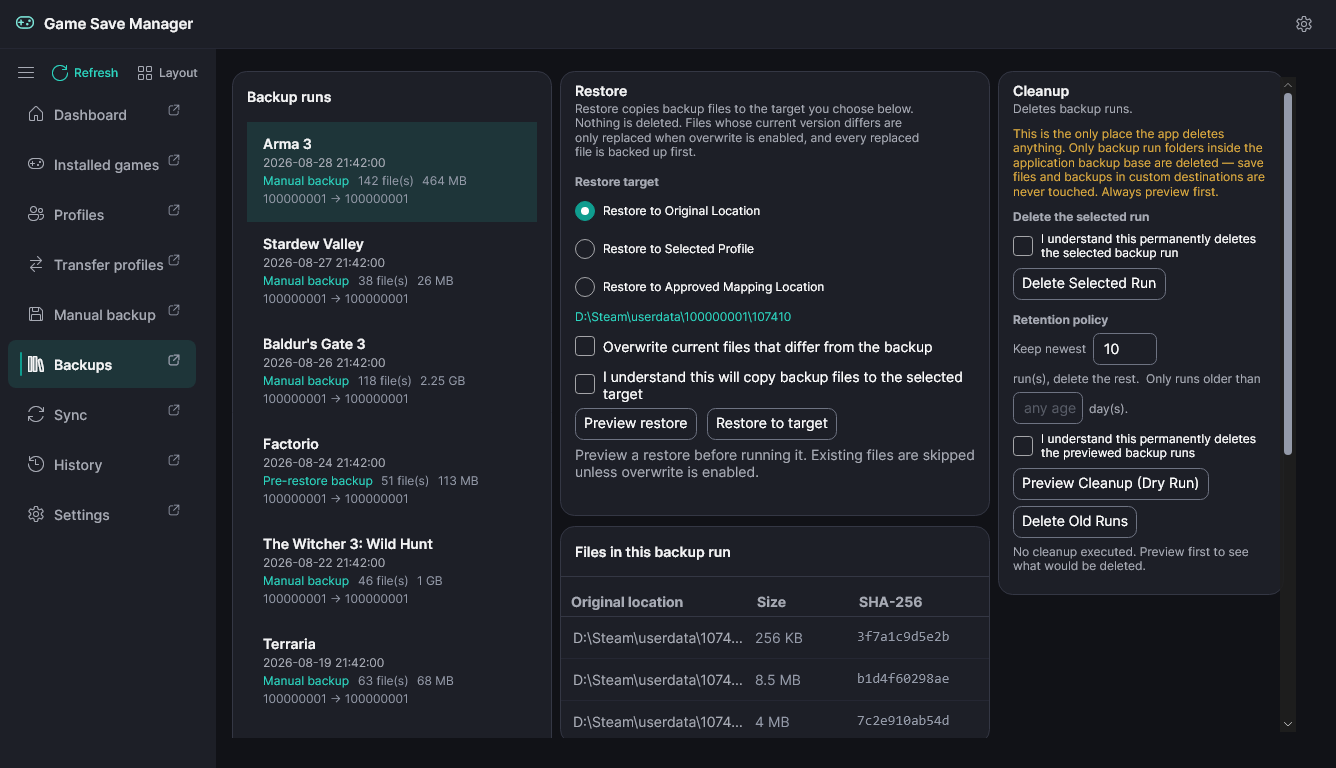
The Backups page with workspace sections dragged out of the centre and docked into the left and right regions: the backup run list on the left, the cleanup controls on the right, restore and run files filling the middle. An IDE-style three-column workspace. Dark mode, teal accent.
The Manual backup page with sections docked above and below the centre region, showing that docking is not limited to side rails. Dark mode, indigo accent.
The Backups workspace after the splitters were dragged, giving the left and right regions deliberately unequal widths. Dark mode, violet accent.
The Transfer profiles page arranged into a custom workspace - inputs across the top, summary on the left, preview results on the right, one section collapsed - the kind of layout that can be saved under a name and restored later. Dark mode, rose accent.
The Dashboard workspace after Reset returned it to the default arrangement - the closing shot of the docking story. Dark mode, indigo accent.
01 / 06
The controls, then the pairs: normal beside High Contrast, 85% beside 125% text size.
Use the previous and next buttons, or the left and right arrow keys, to browse the screenshots. Home shows the first screenshot and End shows the last.
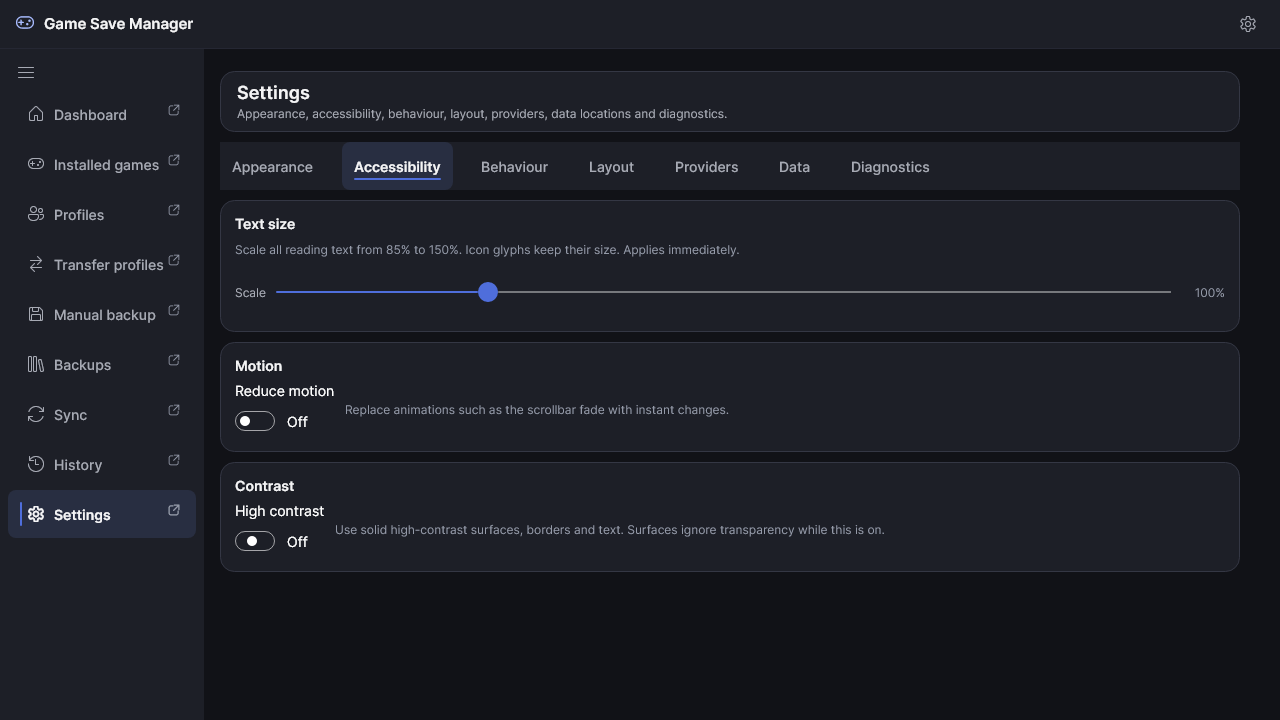
The Accessibility category in normal dark mode: the text-size slider (85% to 150%), the Reduce motion switch, and the High contrast switch, each with an explanation. Indigo accent.
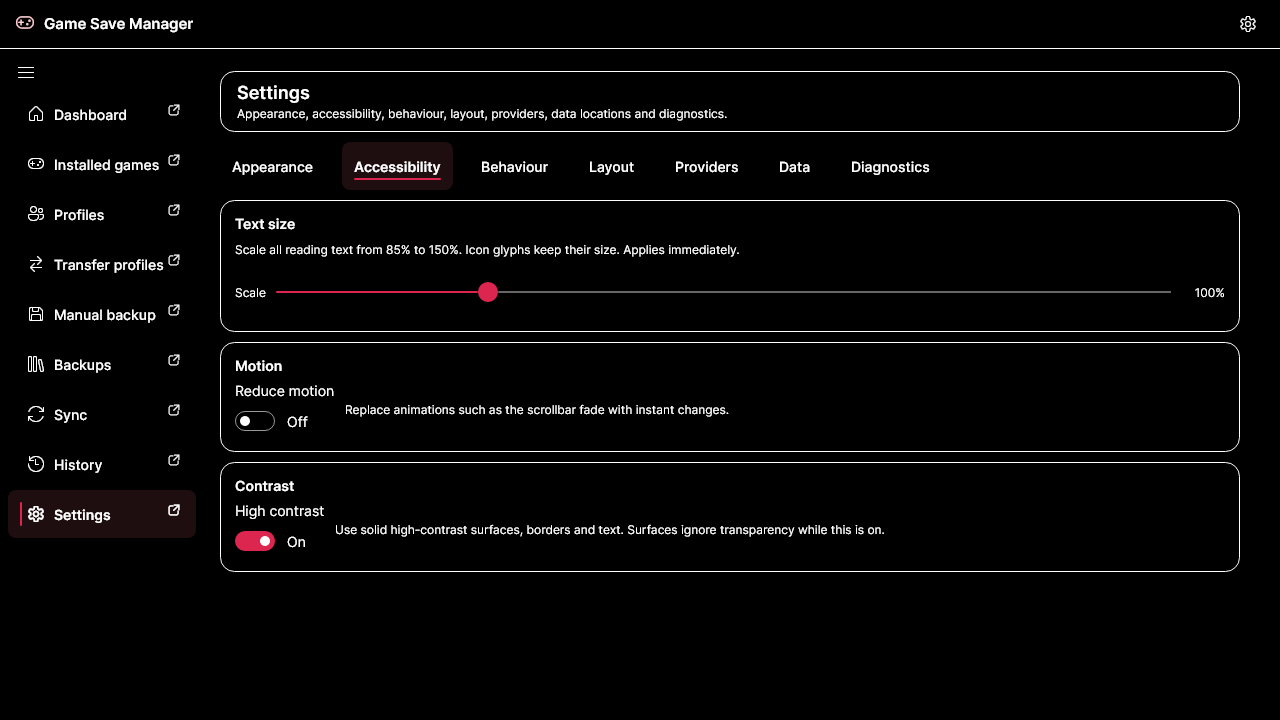
The same category with High Contrast switched on: pure black surfaces, white text and strong borders on every card, and the rose accent used for the slider and the switch. High Contrast deliberately disables window transparency, so nothing shows through.
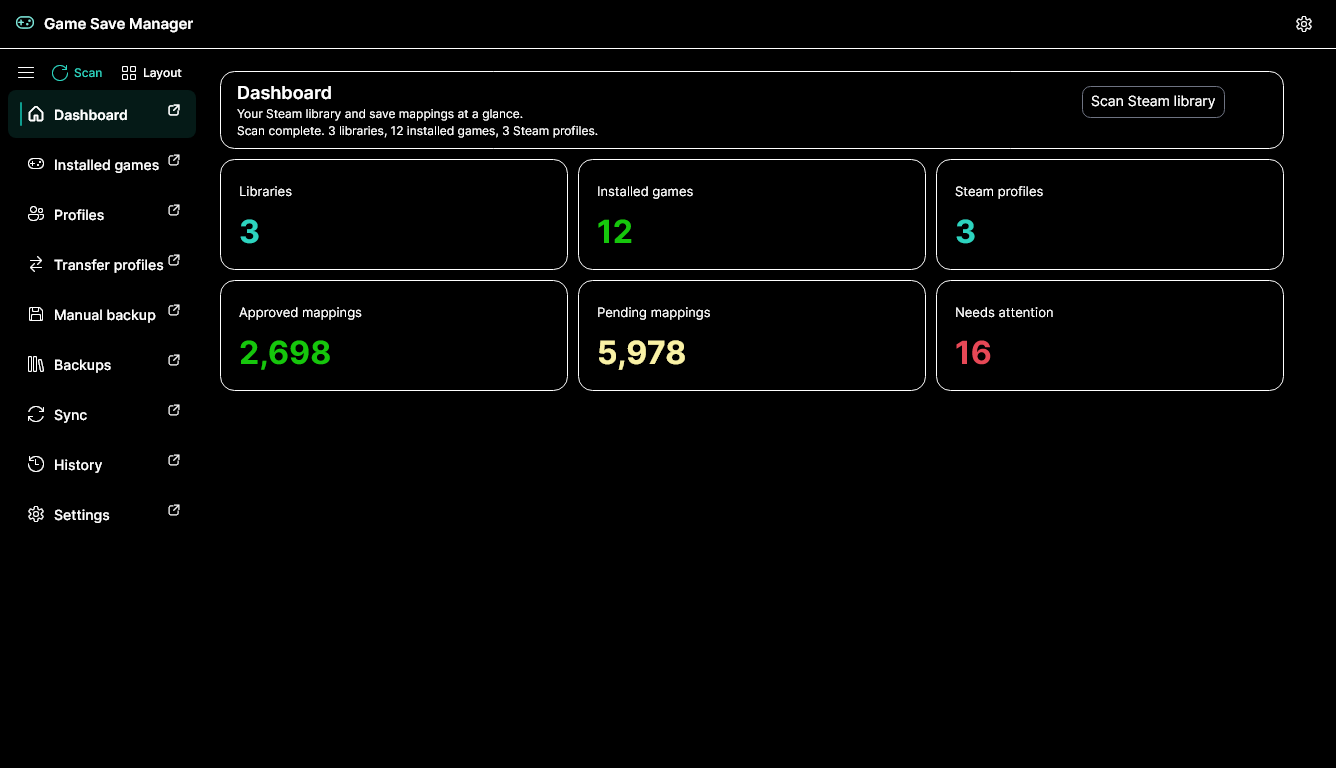
The Dashboard rendered with High Contrast on - the same six stat cards as the tour's first capture, drawn with maximum-contrast surfaces and borders. Teal accent.
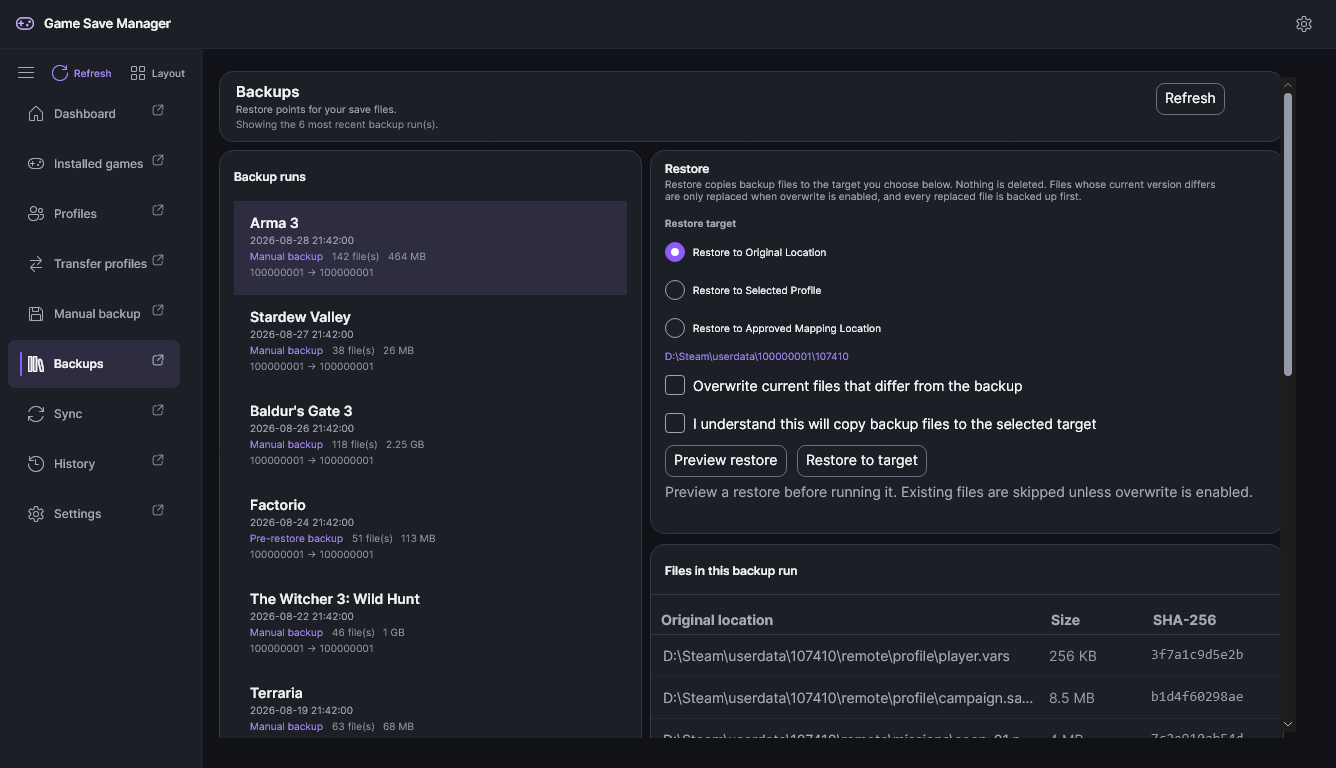
The Backups page at 85 per cent text size - the denser end of the range, fitting more backup runs and more file rows on one screen. Dark mode, violet accent.
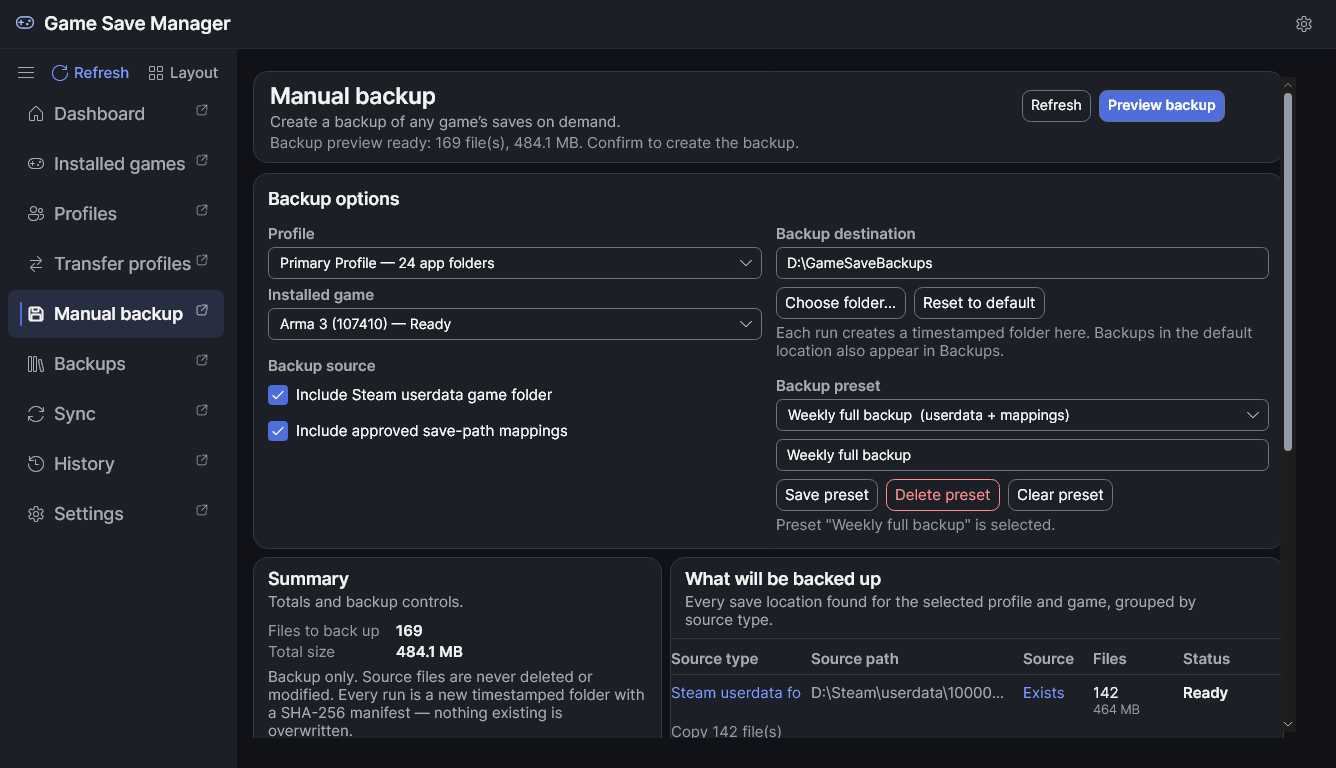
The Manual backup page with the accessibility text size set to 125 per cent. Every label, field and button has grown and the layout has reflowed to fit - nothing is clipped. Dark mode, indigo accent.
01 / 05
The rail moved to the right and to the top, and collapsed to icons on either side.
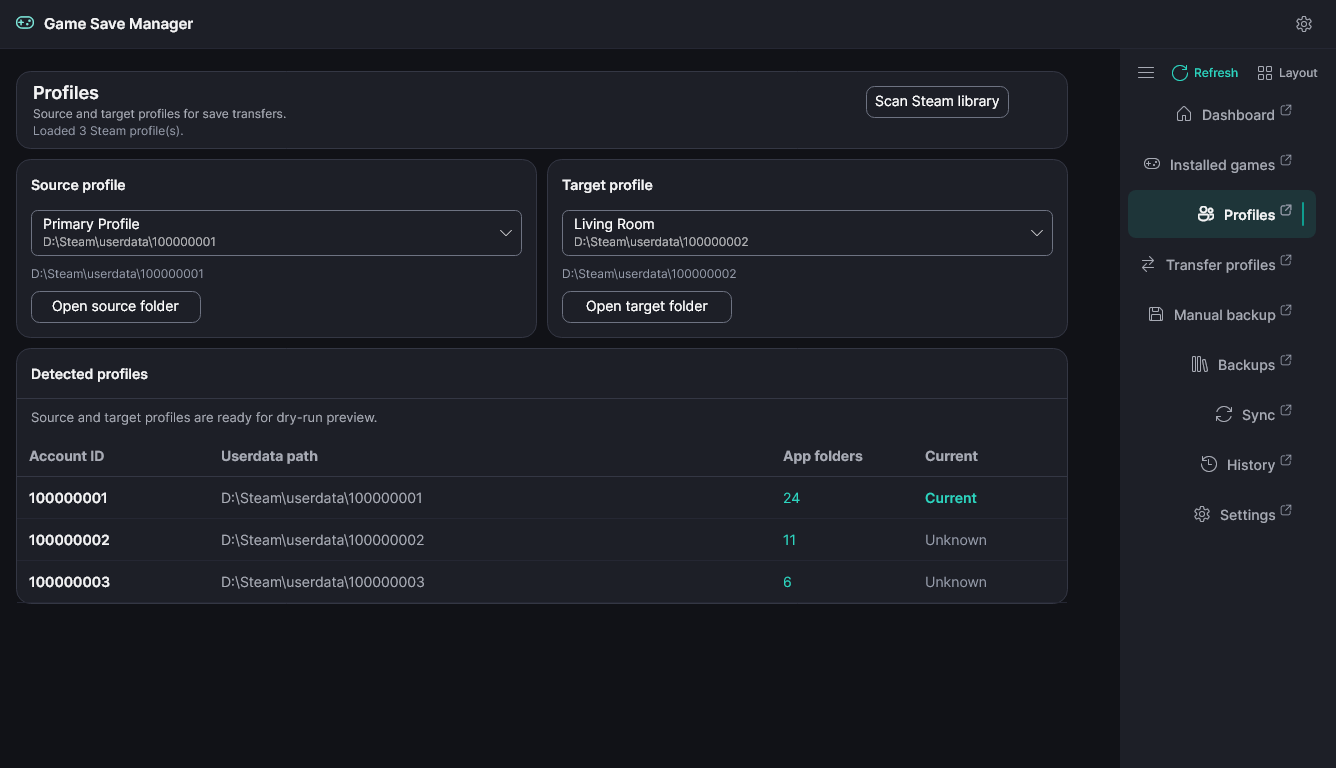
The Profiles page with the navigation rail moved to the right-hand side of the window, still expanded with icons and labels. Dark mode, teal accent.
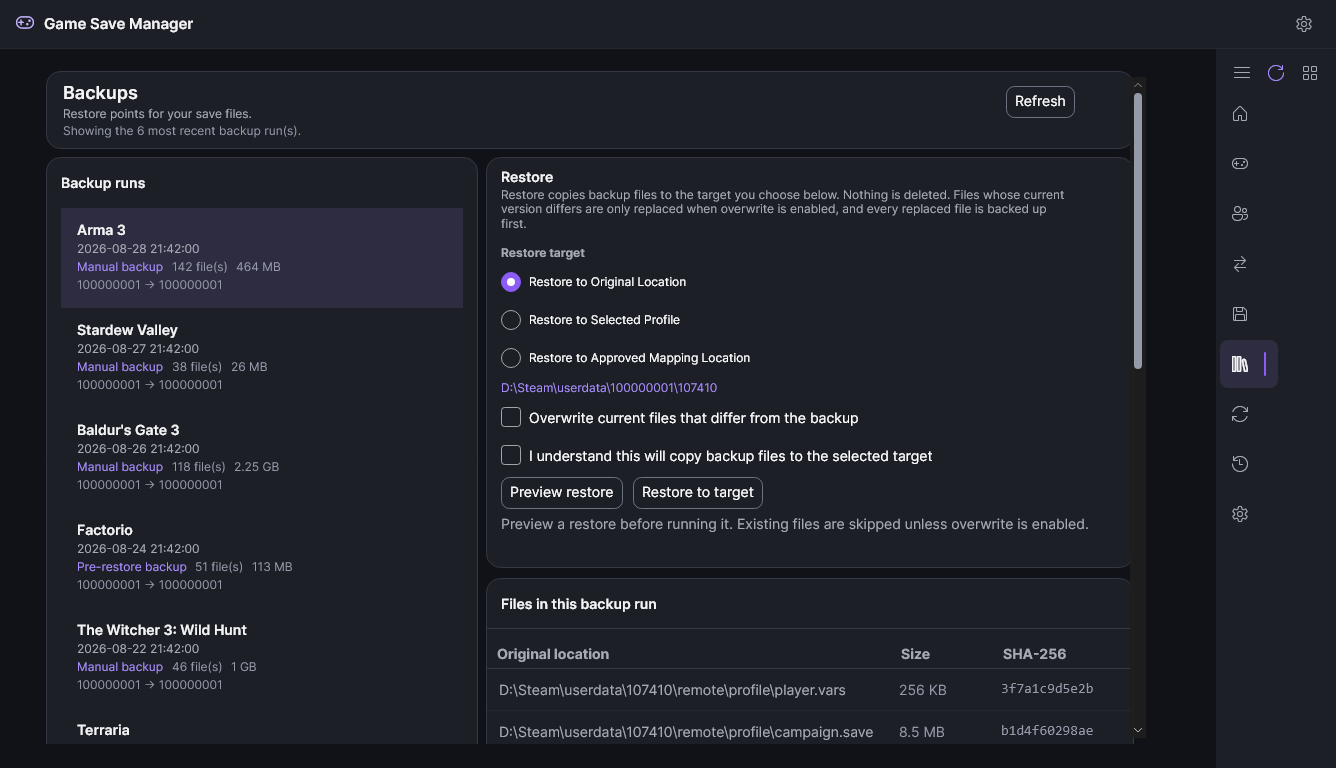
The Backups page with the right-hand rail collapsed to a narrow icon strip, giving the page its full width back. Dark mode, violet accent.
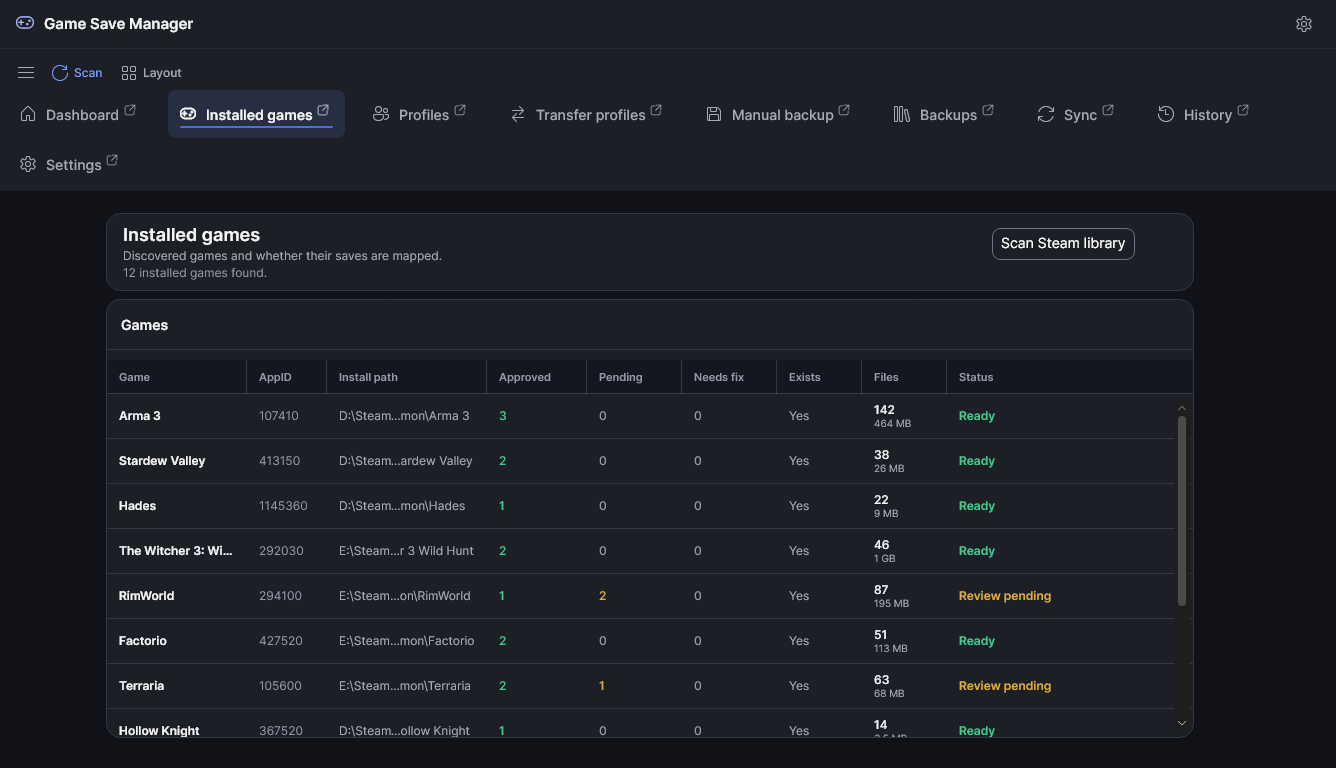
The Installed games page with the navigation moved to the top of the window as a horizontal bar, wrapping onto a second row. Dark mode, indigo accent.
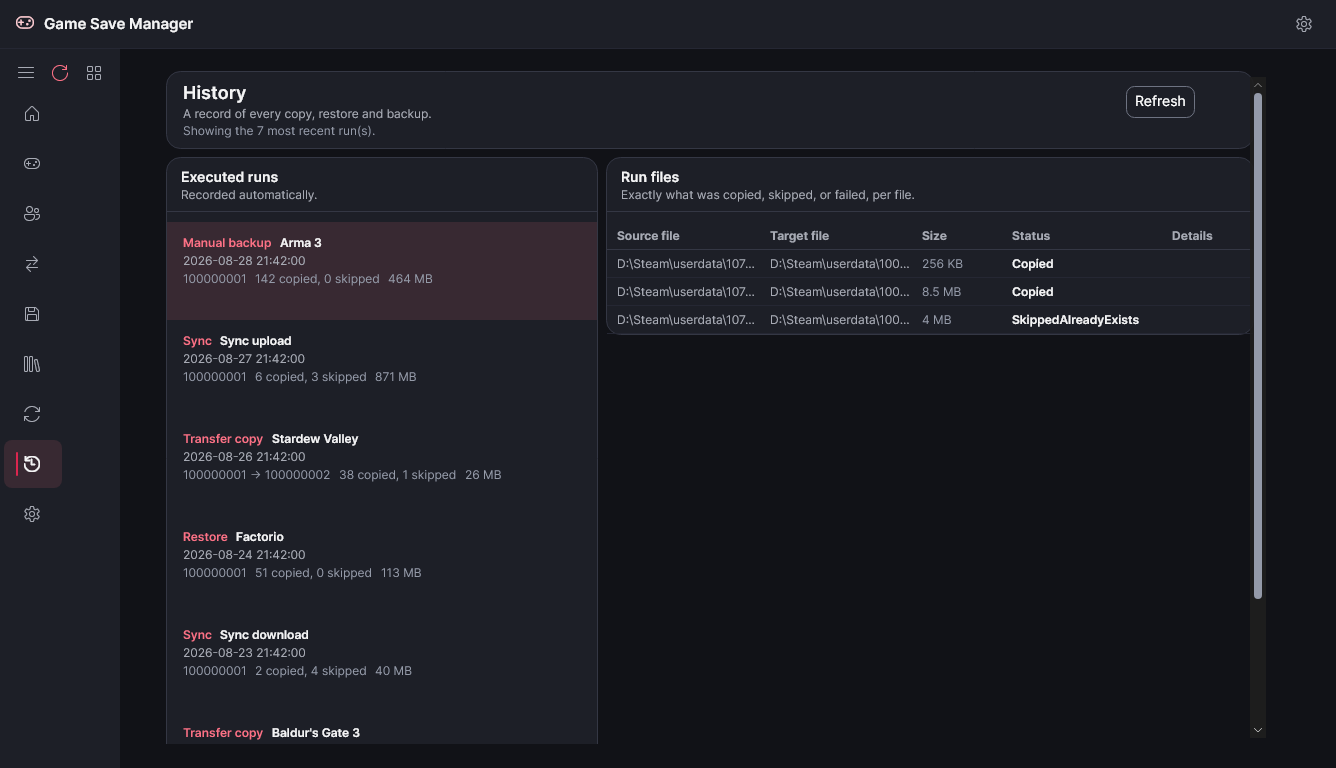
The History page with the default left rail collapsed to icons. Dark mode, rose accent.
01 / 04
Each implemented provider - local folder, SFTP, Google Drive - then a sync preview and a completed run.
Use the previous and next buttons, or the left and right arrow keys, to browse the screenshots. Home shows the first screenshot and End shows the last.
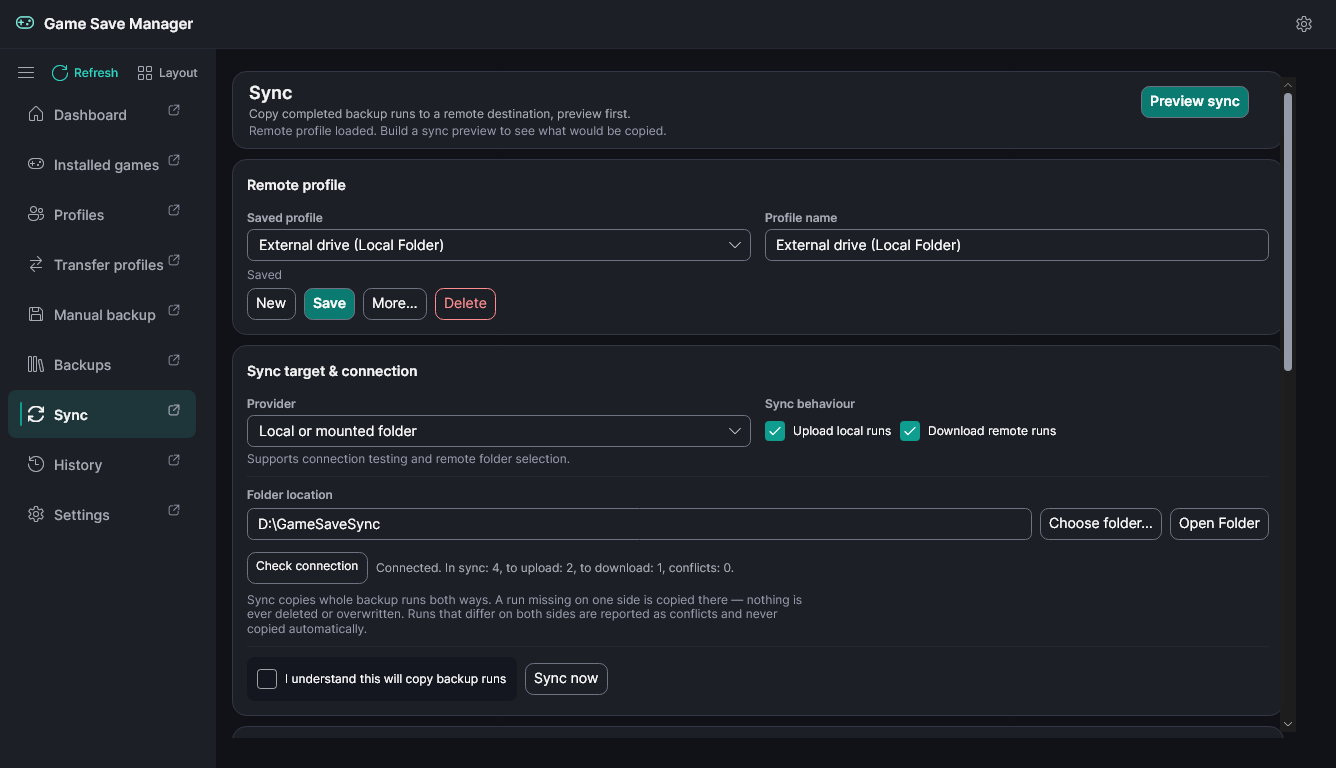
The Sync page configured against a local or mounted folder - the way to synchronise through a drive, a network share, or a folder another cloud client already keeps in sync. Shows the saved remote profile, the provider choice, the target path and the upload and download switches. Dark mode, teal accent.
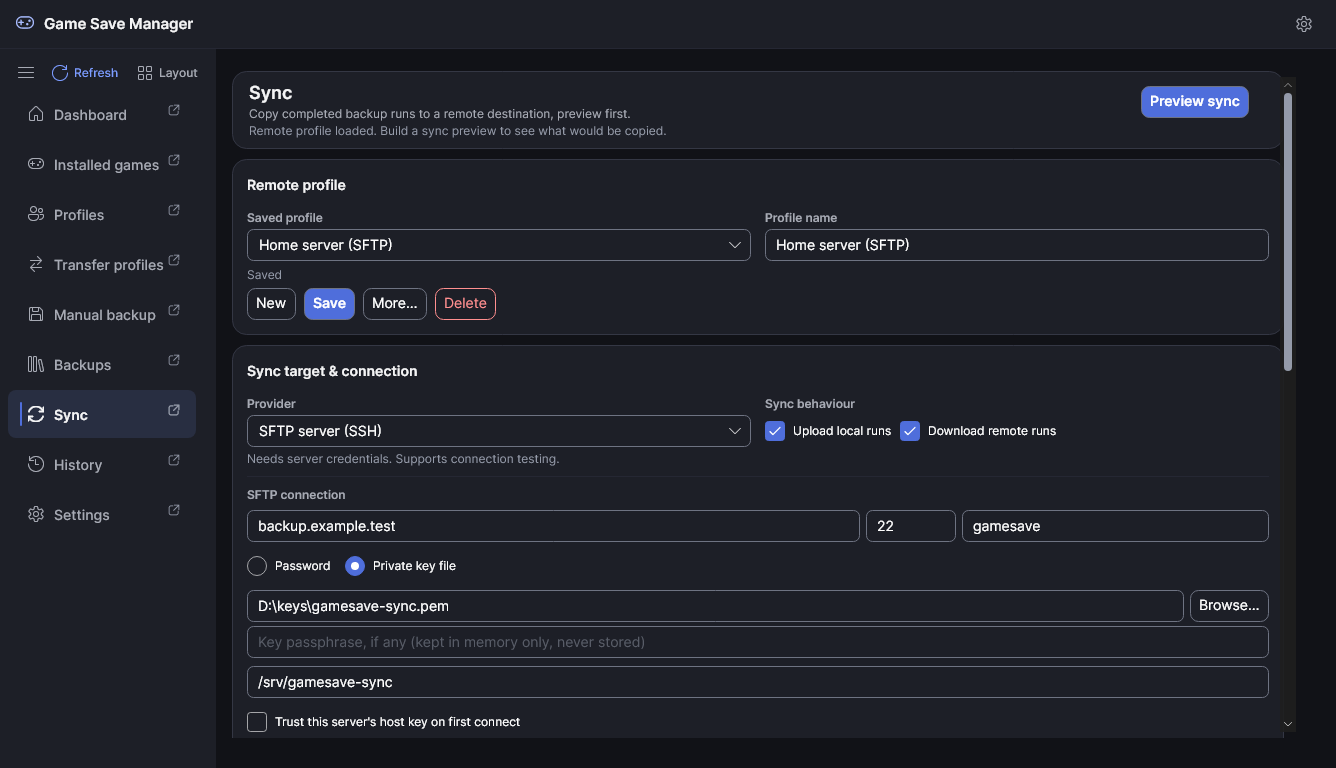
Configured for an SFTP server: the saved profile, the host, port and user name, the choice between password and private key with the key file selected, the remote path, and the first-connect host-key trust switch. The host is a reserved example domain and never resolves. Dark mode, indigo accent.
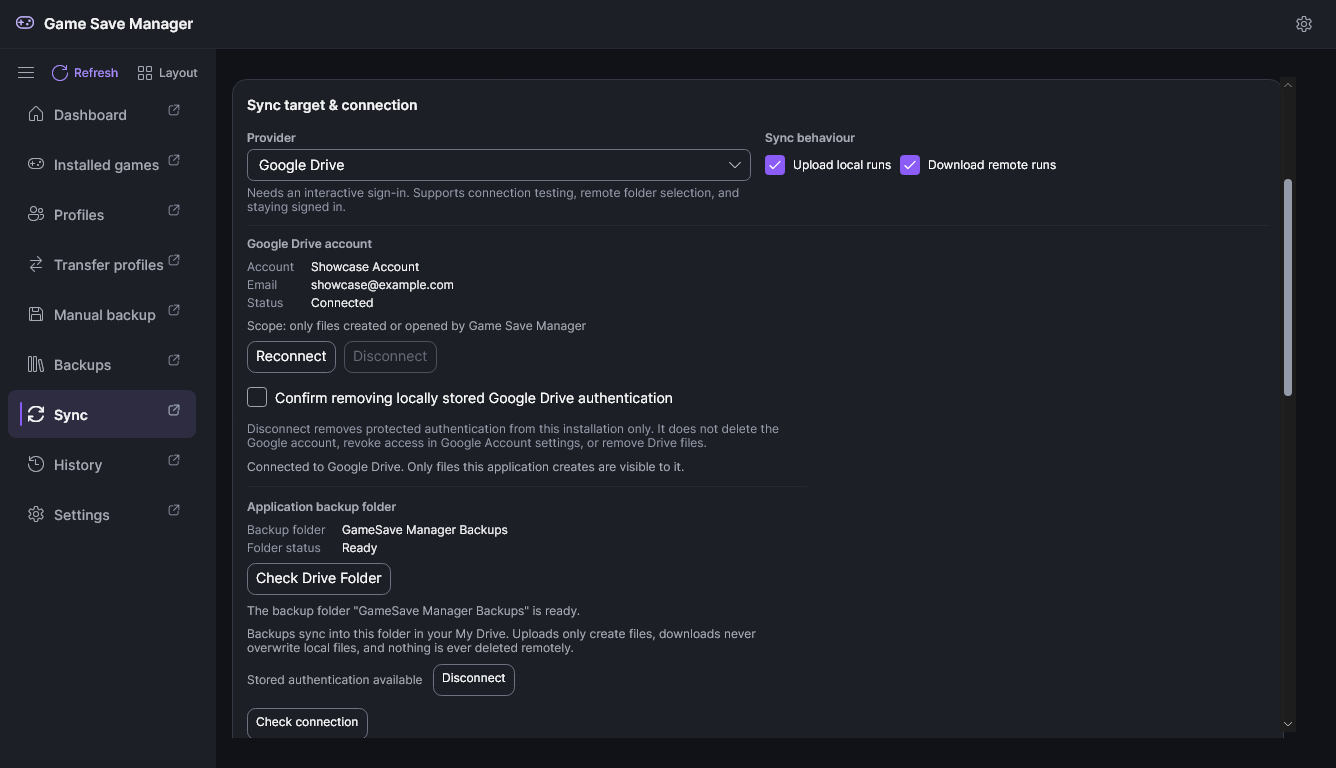
Connected to Google Drive: the saved profile, the signed-in account and e-mail, the Connected status, the scope note stating the application only sees files it created itself, the Reconnect and Disconnect actions, and the application-managed backup folder marked Ready. Dark mode, violet accent.
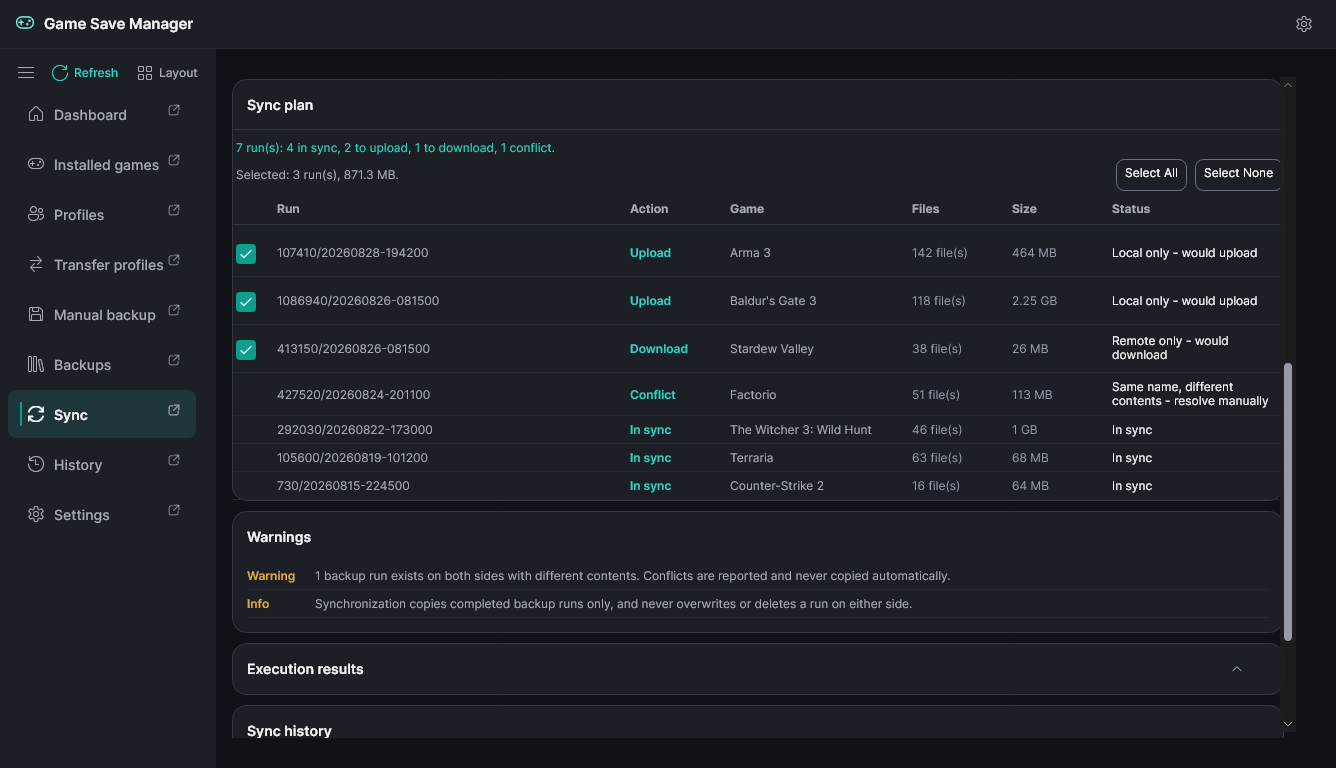
The sync plan before anything is copied: seven completed backup runs, each marked Upload, Download, Conflict or In sync with a tick box to include or exclude it, the totals above, and two warnings below - a run that exists on both sides with different contents is never copied automatically, and synchronisation never overwrites or deletes either side. Dark mode, teal accent.
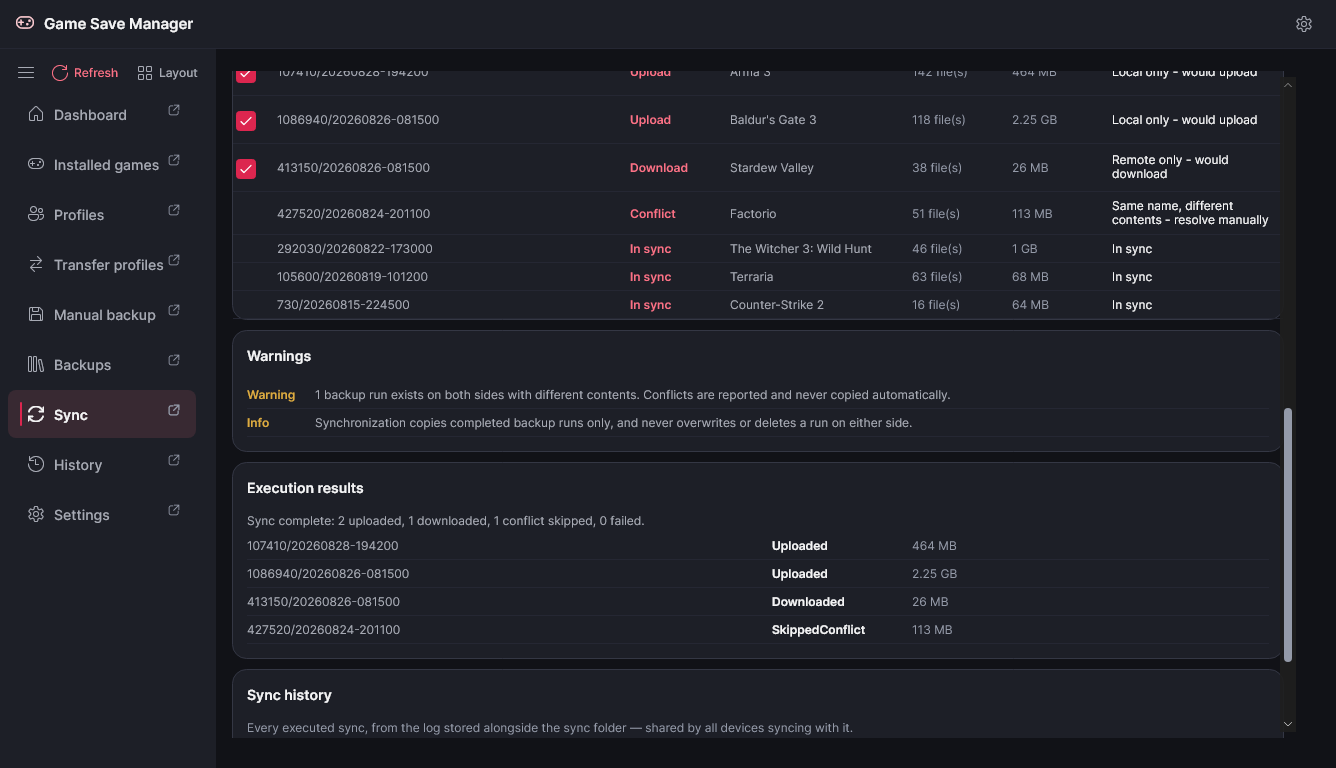
After a run: the plan at the top, the warnings, then the execution results - 2 uploaded, 1 downloaded, 1 conflict skipped, 0 failed - listed per run with sizes, and the sync history below. Dark mode, rose accent.
01 / 05
The problem
PC games store saves across Steam userdata, documents, AppData, installation directories and custom locations. Players often only discover that complexity when moving between profiles or recovering from data loss.
Game Save Manager turns those inconsistent locations into a reviewed mapping system and a set of guarded workflows. The goal is not simply to automate file copying, but to make every action understandable before it runs and recoverable if something goes wrong.
Implemented application
Three roadmap phases are complete: discovery and transfer, backup and restore, and sync through local folders, SFTP/SSH and Google Drive. Phase 04, the interface revamp, is what the gallery above shows.
01
Finds the Steam installation, additional libraries, installed games and local Steam profiles by reading registry and VDF data.
02
Previews files before copying between Steam profiles, validates path containment, skips existing files by default and requires explicit confirmation.
03
Creates manual and automatic backups with SHA-256 manifests, supports dry-run restore, presets, retention and self-contained ZIP export/import.
04
Synchronises completed backup runs through local-folder, SFTP/SSH and Google Drive providers on one preview-and-execute contract, with connection checks, selectable plans, live progress and conflicts that are reported rather than silently resolved.
05
Every page is a set of sections that can be docked left, right, above or below the centre, resized, collapsed, floated into their own window, saved under a name and reset to the default arrangement.
06
Light, dark and system themes, five accents, Acrylic and Mica window materials, a navigation rail that docks left, right or top, reduced motion, High Contrast and a text scale from 85 to 150 per cent that reflows every layout.
Living save-path dataset
The dataset is built continuously by fetching Steam AppIDs and harvesting save-location candidates primarily from PCGamingWiki, while manually researched paths can be added alongside them.
120k / ~ 170k
Steam AppIDs processed so far
5,978
Games with collected mappings
2,698
Mappings reviewed and approved
Current development snapshot. Approximately 70% of the target Steam AppID catalog has been processed; 5,978 of those entries currently have mapping data, and 2,698 mappings are approved for trusted application use.
≈ 2,000 - 3,000 / day
Automated harvesting processes roughly two thousand new catalog entries each day and records candidate paths with their provenance.
Manual + mined
Mappings can also be added or corrected manually, so new titles are not limited to what an automated source can extract.
Continued support
The project will keep supporting new releases. A future direction is letting additional trusted reviewers help approve the growing candidate queue.
From public clue to trusted path
Steam identifies games, but it does not provide one dependable catalogue of where every title stores its save files. Public sources can suggest locations, yet those suggestions may be outdated, incomplete or written for a different operating system.
The pipeline therefore treats collected paths as candidates, not facts. Rule-based checks expand reusable path templates and flag repeatable problems, while human review handles ambiguity and decides which mappings are safe enough to approve. The application uses only those approved mappings when it prepares a backup or transfer preview, reducing the risk of selecting the wrong files or folders.
Steam AppIDs create the catalog queue and tell the pipeline which games still need save-location research.
PCGamingWiki and manual research provide candidate save locations together with their source and context.
Templates are expanded, ambiguous or unsafe paths are flagged, and every candidate receives a visible review state.
Approved paths let the app build clearer previews and target the intended save data during backup and transfer.
Scraped locations can be outdated, incomplete, platform-specific or simply wrong. Candidate data remains visible as Pending or NeedsFix, but the application does not automatically trust it. This keeps dataset growth separate from save-file safety.
Design principles
Save files can represent hundreds or thousands of hours. Guardrails are part of the product, not warnings added at the end.
01
Source saves are not deleted or modified during transfer or restore.
02
Transfers, restores, sync and cleanup expose a dry run before execution.
03
Existing files are skipped unless the user explicitly enables replacement.
04
Safe Mode refuses an overwrite when its automatic backup cannot be completed.
05
SHA-256 manifests identify missing or modified backup files before restore.
06
SQLite history, manifests and per-file results record what every workflow did.
Architecture
The shared core stays independent of Avalonia, SQLite, registry access, VDF parsing and filesystem details. Views bind to view models, while preview generation, containment checks, hashing, persistence and provider behavior live behind testable contracts.
01
Platform-neutral models, contracts, sync plans and transfer rules. It defines what a safe operation means without knowing about Avalonia, SQLite or a particular filesystem.
02
Concrete adapters for Steam discovery, registry and VDF parsing, SQLite, path expansion, backup, restore, history, and the local-folder, SFTP/SSH and Google Drive sync providers.
03
A thin MVVM interface that coordinates explicit services, presents previews and confirmations, keeps provider-specific controls driven by declared capabilities, and hosts the dockable workspace, navigation rail and theme system.
04
Separate developer tools for catalog fetching, PCGamingWiki harvesting, verification and deliberate human approval of candidate mappings before the desktop app trusts them.
Phase 04 · in progress
The provider abstraction is proven rather than promised: local or mounted folders, SFTP over SSH and Google Drive all run on one preview-and-execute contract, with copy-only conflict rules, named remote profiles, connection checks and auditable results. Google Drive brought interactive sign-in, protected locally stored authentication that Disconnect removes, and a managed backup folder scoped to files the application created itself. With that contract stable, Phase 04 rebuilds the interface on top of it: a dockable workspace with saved layouts, a navigation rail that docks left, right or top, five accents, Acrylic and Mica window materials, and an accessibility pass measured at four text sizes. Further synchronisation targets are being weighed against the same contract, not written yet.
Delivered
Local-folder, SFTP/SSH and Google Drive providers on one capability catalog, provider factory and remote-profile store, with selectable plans and conflicts reported rather than resolved.
In progress
The interface revamp: dockable regions with saved layouts, a rail that docks left, right or top, five accents, Acrylic and Mica, High Contrast, reduced motion and an 85–150% text scale.
Planned next
More synchronisation targets. WebDAV, OneDrive and others are being evaluated against the existing contract before any is committed to; cross-platform support follows.
Roadmap
Each phase ships before the next one starts. Further sync targets are evaluated against the shipped provider contract rather than announced, and planned functionality is never presented as implemented.
Engineering lessons
Active development